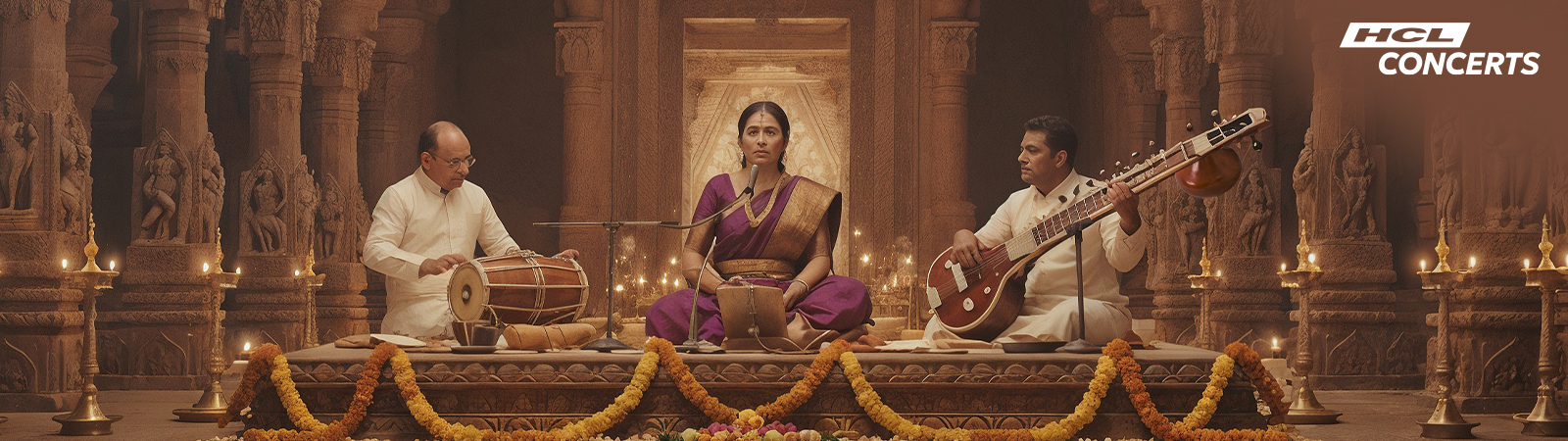
A Complete Guide to Carnatic Music
2025-11-28Rooted deeply in South India, Carnatic music is one of the country’s oldest and refined classical traditions. It blends melody and rhythm in ways that speak to the senses and the soul. Whether you are sitting in a temple hall or streaming a concert online, the experience is rich and direct. This guide aims to explain Carnatic music. We will cover its origins and history, introduce the great composers, explore how all ragas in Carnatic music work, highlight instruments in Carnatic music, explain the format of a typical concert, and see how the tradition is evolving in the modern world. If you are curious about Carnatic classical music or want to learn where to begin, this guide is for you.
Origins and History
The roots of Carnatic music stretch far into India’s ancient times. In the southern states, words about music and sound appear in old texts and temple practices. The interplay of voice, melody and rhythm emerged from devotional singing and ritual performance.
The Bhakti movement, which swept through much of India, played a major role in shaping this tradition. Poets and saints composed songs in regional languages, often addressed to deities, and music became a way of devotion. In South India, this devotional spirit helped refine the music into the form we know today.
Over the centuries, the system of melody (raga) and rhythm (tala) became finely developed. In temples, courts and homes across Tamil Nadu, Karnataka, Kerala and Andhra Pradesh, musicians laid down patterns of practice and composition that held strong. The organisation of concerts, teaching methods and compositions became more formal. The initiative HCL Concerts has played a role in bringing this tradition to larger audiences. HCL Concerts has reached over 140 million viewers across many countries and has helped the classical tradition stay vital.
| Time Period | What Happened | Why It Matters |
|---|---|---|
| Ancient & Temple Era | Music was part of temple rituals, and early forms of melody and rhythm took shape. | This laid the base for today’s raga (melody) and tala (rhythm) systems. |
| Bhakti Movement | Saints and poets composed devotional songs in local languages for everyone to sing. | Music became easier for people to understand and joined daily life and worship. |
| Classical Era | Musicians developed structured compositions and formal concert styles. | This helped create the strong tradition and set rules that guide performances today. |
| Modern Era | Digital learning, global concerts, and online teaching became common. | Carnatic music reached wider audiences and continues to grow across the world. |
The Great Composers
In Carnatic music, certain composers are central to the tradition. Their works, their lives, and their innovations still deeply influence students and performers today.
Tyagaraja (1767–1847)
Tyagaraja is widely regarded as the greatest composer in the Carnatic tradition. He was born in Tiruvarur in Tamil Nadu and spent much of his life composing devotional songs, especially in praise of Lord Rama. His compositions softly fuse melody and meaning, and many of them are staples in concerts today. He did not work as a court musician but chose a life dedicated to devotion and music. His Pancharatna Kritis (five gems) remain important. They are still sung at festivals and concerts around the world. Importantly, Tyagaraja’s music speaks directly to the listener; it is both scholarly and deeply heartfelt.
Muthuswami Dikshitar (1776–1835)
Muthuswami Dikshitar, another pillar of the tradition, composed in Sanskrit and often under the signature “Guruguha.” He was born in Tiruvarur as well, and his compositions are known for their poetic descriptions of temples, deities and the natural world. Dikshitar’s approach to melody emphasised the veena style and rich ornamentation. Many performers seek to master his compositions for the depth and grandeur they offer. His works also broadened the scope of the tradition in terms of instrumentation and musical texture.
Syama Sastri (1762–1827)
Syama Sastri was the eldest of the “trinity” of composers and perhaps less prolific in the number of compositions than the others, but very deep in musical quality. He worked largely in praise of the Goddess Kamakshi and used rich rhythms and devotional intensity in his songs. His compositions often explore complex tala patterns and gamakas. The strength of his work lies in its depth, dignity and devotion. Together, these three composers laid the bedrock of modern Carnatic classical practice.
Contemporary Artists
In today’s world, the tradition of Carnatic music is carried forward by gifted performers who bring fresh energy while preserving the past. For example, S. Sowmya is a highly acclaimed vocalist who began learning from her father and later eminent gurus. She has a large repertoire and is known for both musical discipline and emotional impact.
Meanwhile, Sandeep Narayan represents a younger voice in the tradition. Born in Los Angeles and trained partly in the United States, he moved to Chennai to ground his craft in tradition. His journey shows how Carnatic music is now global, yet firmly rooted.
Each of these artists adds to the living history of the tradition, reminding us that Carnatic music is not just ancient but very alive.
Understanding Ragas and Talas
When you hear a fine Carnatic concert, the terms “raga” and “tala” will often appear. Understanding them makes your listening richer and more engaged.
Ragas
A raga is the melodic heart of Carnatic music. It is much more than a scale of notes. It defines which notes can be used, how they can be approached, and how phrases should flow. Each raga expresses a distinct mood or emotion, such as devotion, serenity, or joy. The performer explores these moods through improvisation and subtle ornamentation known as gamakas.
In the Carnatic tradition, there are 72 parent ragas, known as the Melakarta ragas. From these, a large number of Janya ragas (derived ragas) have evolved, each with its own beauty and mood. Mastering all ragas in Carnatic music is a long journey, as every raga carries a personality shaped by its unique combination of notes and emotional depth.
Below are five of the most common and widely performed ragas:
| Raga | Mood / Emotion | Description |
|---|---|---|
| Kalyani | Bright and uplifting | Often associated with joy and grace, Kalyani is used in many major compositions. It is versatile and rich, suitable for both slow and fast pieces. |
| Bhairavi | Devotional and serious | Deeply expressive, Bhairavi conveys both devotion and sorrow, often chosen for closing pieces. |
| Todi | Intense and emotional | Known for its intricate phrases, Todi carries a feeling of yearning and deep emotion. |
| Shankarabharanam | Majestic and balanced | Similar to the Western major scale, it expresses harmony and is often used in teaching beginners. |
| Kharaharapriya | Calm and soothing | A graceful raga that allows wide improvisation; often associated with compassion and introspection. |
Each of these ragas creates a unique experience in a concert. When performed live, you can feel how the artist uses each phrase to bring out emotion and story through melody alone.
Talas
If ragas provide melody, tala provides rhythm. A tala is a structured cycle of beats that repeats throughout a song or improvisation. It gives the composition its tempo and framework, allowing musicians to coordinate and improvise within a shared time cycle.
There are 108 talas, though only a few are used frequently in concerts today. Each tala is made up of smaller parts: Laghu (variable beats), Dhrta (two beats), and Anudhrta (one beat). Musicians mark these beats with claps and finger counts, helping to keep the rhythm steady and interactive.
Here are five of the most commonly used talas in Carnatic classical music:
| Tala | Beats | Usage/ Feel |
|---|---|---|
| Adi Tala | 8 beats (4 + 2 + 2) | The most popular tala, used in a large portion of Carnatic compositions. It offers balance and flexibility. |
| Rupaka Tala | 3 beats | Light and flowing, often used for gentle, lyrical pieces. |
| Mishra Chapu Tala | 7 beats | Known for its lively rhythm, common in dance compositions and lighter songs. |
| Khanda Chapu Tala | 5 beats | Creates an energetic feel and adds complexity to fast-paced songs. |
| Jhampa Tala | 10 beats | Rare and intricate, used for compositions requiring detailed rhythmic patterns. |
Together, raga and tala form the foundation of every Carnatic piece. The raga brings emotion and depth, while the tala gives it life and pulse. When both align perfectly, they create the timeless beauty that defines the best Carnatic music performances.
Raga + Tala in Performance
When singers or instrumentalists perform, they often begin with a slow exploration of the raga (Alapana). The rhythm may enter later, and the tala framework will guide improvisation (Kalpanaswaram, Niraval). The emotional power of Carnatic music comes from this blend. The raga gives a feel, the tala gives structure, and the improvisation gives freedom. Here’s a simple comparison:
| Element | What it means | What you feel |
|---|---|---|
| Raga | Melody framework with rules and character | Mood, identity |
| Tala | Rhythmic cycle and grouping | Pulse, time-flow, momentum |
| Raga + Tala | Combined in a live performance | Music that moves and touches the heart |
Thus, understanding raga and tala gives you a deeper sense of why a concert sounds the way it does. When you listen to what is called the best Carnatic music, you are hearing a skilled interplay of raga and tala at work.
Key Instruments in Carnatic Music
While the human voice is central in Carnatic classical music, a rich range of instruments supports, enhances and sometimes leads. If you wish to explore further, the topic of instruments in Carnatic music is worthy of dedicated study. Below is a short overview that links to that deeper world.
| Instrument | Role in Ensemble | Notes |
|---|---|---|
| Veena | Plucked string, often solo or lead | An ancient instrument with a rich tone |
| Violin | Melodic accompaniment & solo | Adapted from the tradition of the West |
| Mridangam | Principal percussion | The two-headed drum anchors the tala |
| Ghatam / Kanjira / Morsing | Supporting percussion | Mood, texture, rhythmic variation |
| Flute (Venu) | Wind melodic instrument | Soft, lyrical and often used for solo support |
In a typical concert, you’ll see voice, violin and mridangam at the core. Other instruments may join depending on the scale of the event. The interplay between voice and instruments is what gives the performance its richness.
Format of a Carnatic Concert
If you attend or watch a Carnatic music concert by video, you may wonder about the order and progression of the pieces. Familiarity with the layout helps you appreciate the flow and why certain pieces appear at certain times. Here is a typical sequence:
- Varnam: Usually, first. Varnam is a warm-up composition that sets the mood and introduces the raga clearly.
- Kritis: Several main songs. These compositions by great composers form the heart of the programme. They have lyrical content, melody, structure and often allow improvisation around them.
- Ragam–Tanam–Pallavi (RTP): Often the central, extended piece. It begins with raga exploration (alapana), moves into rhythmic improvisation (tanam) and then a set theme (pallavi) is taken up and varied creatively.
- Lighter/Devotional Pieces and Tillana: Towards the end, you will hear lighter compositions, rhythmic pieces and sometimes a tillana (fast, playful piece) to conclude.
- Percussion Solo (Tani avartana): Often near the end, the percussion artists take the stage before the final piece, showing rhythmic mastery.
This format gives the audience a journey, from introduction to deep exploration to uplifting closure. It also gives the artists space to showcase composition, improvisation, voice, rhythm and stamina.
Modern Evolution and Global Influence
Although rooted in tradition, Carnatic music has embraced change and expanded far beyond its original geography. Today, you will find Carnatic music online, accessible to learners and listeners worldwide. Platforms like HCL Concerts deliver live-streamed performances, virtual concerts and archives of repertoire for global access.
Some key developments:
- Digital Access & Online Teaching: Students anywhere can now learn the craft via online lessons, video classes, apps and virtual masterclasses.
- Fusion & Cross-Genre Work: Some artists blend Carnatic with jazz, world music or electronic elements while retaining raga and tala foundations. For example, Sandeep Narayan blends classical training with newer musical idioms.
- Global Audiences: Concerts are held overseas, recorded streams reach multiple countries, and the tradition finds new listeners outside South India.
- Inclusive Platforms & Formats: Organisations like HCL Concerts also promote inclusive and independent music via initiatives such as Soundscapes and Baithaks.
Another key initiative by HCL Concerts is Carnatic Quest, a nationwide talent hunt aimed at discovering and nurturing young artists passionate about Carnatic music. Open to both vocalists and instrumentalists across junior and senior categories, the programme gives winners a chance to receive mentorship from established musicians and perform on the HCL Concerts stage. It reflects HCL’s commitment to preserving tradition while encouraging the next generation to carry forward the rich legacy of Carnatic classical music. Thus, the tradition of Carnatic and Hindustani music (though distinct) is part of a broader shift; Indian Classical Music is being shared globally, learned online, and enjoyed by new generations.
Conclusion
In summary, Carnatic music is a living tradition. It is built on ancient roots, enriched by the devotional mood of the Bhakti movement, and shaped by the genius of major composers like Tyagaraja, Muthuswami Dikshitar and Syama Sastri. Its melodic systems (ragas) and rhythmic cycles (talas) form the core, supported by voice and instruments, and expressed in structured concert formats. Today, through platforms like HCL Concerts, this heritage is shared more widely than ever before.
Whether you are drawn to the idea of learning Carnatic classical music, exploring Carnatic music online, or simply listening to the best Carnatic music available, the journey is open and full of reward. The instruments, the composers, the formats and the global context all invite you in. Take a moment to listen closely, attend a concert (live or streamed), and let the magic of this tradition move you.