Raag Yaman in Hindustani Classical Music: Structure, Swaras and Significance
2026-02-27Ever noticed how a single note at dusk feels like a prayer floating in the air? That gentle glow, that quiet magic, often belongs to raag yaman. If you are stepping into the world of Hindustani classical music, Yaman is usually your first companion. It welcomes you with grace and depth. It teaches you how the melody breathes.
This raga holds a special place in the heart of Indian classical music. Students begin their journey with it, masters return to it repeatedly, and the audiences feel instantly at home in its soothing phrases. In this guide, let us explore the structure, swaras, and the true importance of Raag Yaman.
You will discover how its musical notes unfold, why it shines in evening performances, and how it continues to inspire artists on the grand stages of HCL Concerts. Ready to immerse yourself in its golden glow? Let us begin.
What Is Raag Yaman?
At its core, Raag Yaman is a foundational Hindustani raga. It belongs to the Kalyan thaat and is often one of the first ragas taught to beginners. Think of it as the doorway to the vast universe of Hindustani classical music. When you learn Yaman, you learn how to handle pitch, emotion, and improvisation with care.
It uses the sharp Ma, known as Tivra Ma, which gives it a luminous quality. That one note changes the entire mood. It feels expansive and uplifting. Many teachers introduce Yaman early because:
- It trains your ear to recognise subtle pitch shifts
- It builds confidence in alap and taan
- It lays the groundwork for understanding other ragas
Origins & Cultural Significance of Raag Yaman
Yaman traces its roots to ancient melodic traditions of North India. Over centuries, it evolved within royal courts and spiritual gatherings. Some scholars link its name to “Imaan” or “Yaman,” hinting at cultural exchanges during medieval times.
Yet its soul remains deeply Indian. It flows through temple music, courtly performances, and classical music concerts alike. It stands as a symbol of serenity and devotion. When performed with care, it feels like twilight itself turning into sound.
You will hear Yaman in:
- Evening mehfils under soft lights
- Devotional compositions praising Lord Krishna
- Contemporary fusion pieces that bridge tradition and today
Why Yaman Is Important in Hindustani Music
Ask any guru why students begin with Yaman, and you will hear a smile in their answer. Yaman builds discipline. Many maestros began their training with Yaman before mastering complex ragas. It is the grammar that shapes expression. It sharpens your pitch sense and teaches you to move between notes without losing emotional flow.
For vocalists and instrumentalists, it offers:
- A strong base for voice culture
- Practice in slow elaboration during alap
- Confidence in improvisation
Musical Structure of Raag Yaman
Now, let us look at how this raga is built. Do not worry about heavy theory. It is like a structure, like a map that guides your musical journey. Yaman follows a specific pattern of ascending and descending movements. These patterns shape how you sing or play it, and ensure the raga retains its identity.
Aroha and Avaroha
The ascending scale, or Aarohan, flows like this:
- Ni Re Ga Ma( tivra ) Pa Dha Ni Sa
The descending scale, or Avarohan, moves as:
- Sa Ni Dha Pa Ma( tivra ) Ga Re Sa
Notice how Sa often begins with Ni in ascent. This creates a gentle lift. On the other hand, the Tivra Ma shines brightly in both directions. These musical notes create Yaman’s signature glow.
Pakad & Chalan
Every raga has a heartbeat. In Yaman, that heartbeat lies in its pakad. Common phrases include:
- Ni Re Ga, Re
- Ga Ma Pa, Dha Ni Sa
- Ni Dha Pa, Ma Ga Re
These movements define the raga’s character. When you hear them, you recognise Yaman instantly. The chalan, or typical flow, glides smoothly. It avoids abrupt jumps. It feels like a calm conversation rather than a dramatic debate.
Vadi & Samvadi Notes
Yaman’s vadi is Ga, and its samvadi is Ni. These notes carry emotional weight. When you emphasise Ga during improvisation, you anchor the melody. When Ni responds, balance returns. This interplay guides artists during alap, bandish, and taan. It also helps you maintain purity while exploring creative space.
Swaras Used in Raag Yaman
Yaman uses seven swaras. All are shuddha except Ma, which is Tivra.
The swaras are:
- Sa
- Re
- Ga
- Ma tivra
- Pa
- Dha
- Ni
There are no Komal notes here. That is why the raga feels bright and open. The sharp Ma adds a sparkle. It separates Yaman from ragas that use natural Ma. When you practise, focus on the smooth transition between Ni and Re. That glide shapes the raga’s mood.
Time Theory & Emotional Mood
In Indian music, time matters. Yaman belongs to the first prahar of the night. It blossoms just after sunset. Imagine the sky turning deep blue, the lamps beginning to glow, and the air cooling. That is when Yaman feels most alive.
Emotionally, it evokes:
- Shringara rasa, the mood of love
- Shanta rasa, the feeling of peace
- A gentle sense of devotion
You may feel reflective, hopeful, even nostalgic. It touches the heart without overwhelming it. That is why audiences often close their eyes during a Yaman performance. The raga wraps around you softly.
Famous Performers and Songs Based on Raag Yaman
Many legends have painted Yaman in their own colours.
- Ustad Rashid Khan brought depth and emotion to his vilambit khayal in Yaman.
- Pandit Bhimsen Joshi infused it with powerful taans and bhava.
- Kishori Amonkar shaped it with delicate nuance.
Even film music draws from Yaman. Songs like “Chaudhvin Ka Chand” echo its structure. Bollywood composers have often borrowed its framework to create timeless melodies.
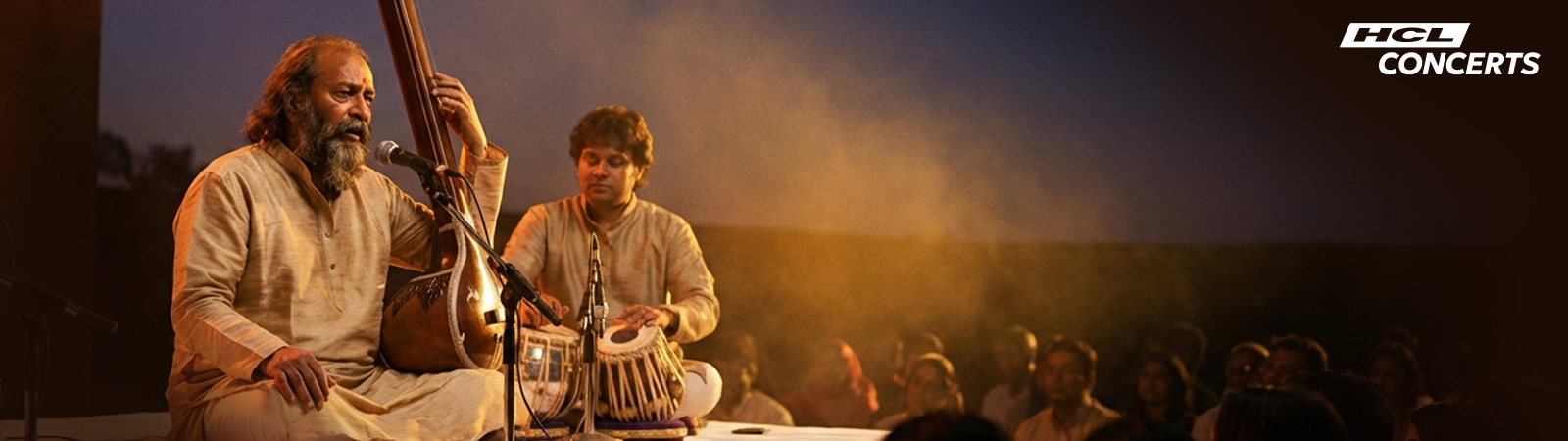
At HCL Concerts, evenings dedicated to Yaman feel like a celebration of heritage, and the tanpura hums. The tabla enters gently. The raga unfolds like a story you have always known.
Famous Bandish of Raag Yaman
Bandish brings structure to improvisation. In Yaman, several traditional compositions stand out. One popular vilambit bandish begins with “Eri Aali Piya Bin.” It allows expansive alap and intricate taans. Another drut bandish sparkles with rhythmic play.
These compositions often praise divine love or express longing. When you sing them, you do not just follow notes. You relive centuries of tradition.
How to Learn & Practice Yaman – Yaman Riyaz
Ready to try it yourself? Begin gently. Start with:
- Sustained Sa and Pa to stabilise pitch
- Slow practice of Aarohan and Avarohan
- Repetition of pakad phrases
Keep your riyaz consistent. Ten to twenty minutes daily builds strength. Record yourself and listen carefully. Notice how Ga and Ni shine. You can also attend live classical music concerts to absorb the raga’s mood. Listening sharpens your understanding faster than theory alone. If you are trained in Carnatic music, you will find similarities with the raga Kalyani. Comparing both traditions deepens appreciation and expands your musical lens. Most importantly, stay patient. Yaman rewards sincerity.
Conclusion
Raag Yaman is more than a scale. It is a feeling. It is the gentle glow of evening translated into sound. It forms the backbone of Hindustani classical music training and continues to inspire performers across generations. When you explore Yaman, you step into a living tradition. You connect with maestros, poets, and listeners who have cherished it for centuries. Whether you are a beginner or a seasoned rasika, Yaman invites you to pause, breathe, and listen deeply.
So, the next time twilight falls, ask yourself, can you hear that soft Tivra Ma shimmering in the air? Join us at HCL Concerts. Experience the magic live. Let Yaman touch your heart and hit you right in the feels.