The Role of the Violin in Carnatic Music: Tradition and Evolution
2026-02-12Ever wondered how a Western instrument became the soul companion of Carnatic music? Imagine you are in a Carnatic concert, where the vocalist sings, and there, shadowing every curve, every pause, and every emotional rise, is the Carnatic violin, mirroring the human voice with such devotion that you can barely tell where the voice ends and the violin begins.
The Carnatic music violin holds a unique position in India’s classical music landscape. It is neither fully foreign nor entirely indigenous, yet utterly essential to the tradition. For over two centuries, this four-stringed wonder has transformed from a curious European import into an irreplaceable voice of South Indian classical music, carrying ragas across generations and touching hearts in ways that transcend language and culture.
Join us as we explore the fascinating journey of the Indian Carnatic violin, from its unexpected arrival on Indian shores to its status as an indispensable pillar of one of the world’s oldest living musical traditions.
Origins of the Violin in Carnatic Music
The violin’s journey into Carnatic tradition is as fascinating as the music it now creates. Originally a Western instrument, the violin was introduced to South India in the late 18th century during colonial times. It was Baluswamy Dikshitar, brother of the legendary composer Muthuswami Dikshitar, who recognised its potential. He adapted the instrument to suit the nuances of South Indian melody and performance style.
What made the violin special? It can mimic the human voice. Carnatic compositions rely heavily on vocal expression, subtle ornamentation, and fluid transitions between notes. The violin’s flexible tonal range made it ideal for capturing these elements. Over time, musicians reimagined how it was played:
- It was positioned differently, resting between the shoulder and ankle.
- Bowing techniques were adapted to match vocal gamakas (ornamentations).
- Tuning was aligned with the main performer’s pitch rather than Western scales.
Soon, the violin moved from curiosity to necessity. It became a trusted partner in performances and an essential component of South Indian musical expression.
Traditional Role of the Violin in Carnatic Music
In Carnatic music, the violin breathes with the music. Its traditional role is beautifully specific yet creatively boundless: the violin is the vocalist’s shadow, companion, and sometimes, gentle challenger.
Accompaniment as an art form
When you attend a Carnatic concert, the violinist sits slightly behind and to the side of the vocalist. But don’t let the positioning fool you. As the vocalist explores a raga’s contours, the violin echoes every phrase, matching tone, gamakas, and emotional colour with stunning precision.
The magical moments
Between compositions, the tani avartanam – a percussion interlude. And before that, the violinist gets their moment: a solo improvisation that showcases their artistry independently. The Carnatic music violin truly sings, demonstrating the depth and range that make this instrument so beloved.
Musical Elements Expressed Through the Carnatic Violin
The genius of the Carnatic violin lies in its ability it captures the essential elements that define South Indian classical music. Let’s explore what makes this instrument so expressive.
Raga interpretation
Ragas are emotional worlds, each with a distinct personality, mood, and rules. The Carnatic violin excels at revealing a raga’s character through precise intonation and ornamentation. The instrument’s ability to produce continuous sound through bowing allows seamless glides between notes, exactly how a vocalist would sing. This creates the smooth, flowing quality (known as gamaka) that defines Carnatic music’s aesthetic.
Tala and rhythmic interaction
Carnatic music’s rhythmic framework (tala) is gloriously complex. During intricate kalpana swarams (improvised note passages), the violinist weaves melodic patterns that land precisely on specific rhythmic counts, creating moments of brilliant mathematical-musical convergence that make audiences gasp.
Emotional expression and storytelling through sound
The violin’s greatest gift is its emotional range. Through variations in bowing pressure, speed, and vibrato, a skilled violinist can evoke everything from devotional surrender to celebratory joy. When rendering compositions about divine love, separation, or spiritual longing, the Carnatic violin becomes a storyteller, painting emotional landscapes with sound alone.
Evolution of the Carnatic Violin
From Tradition to Innovation
The Carnatic violin hasn’t remained frozen in time. Like all living traditions, it has evolved, embracing new possibilities whilst honouring its roots.
- Technical developments: Modern Carnatic violinists have significantly expanded the instrument’s technical vocabulary. Extended techniques, such as rapid bow strokes, pizzicato accents, and harmonic overtones, add new colours to the traditional palette.
- Compositional exploration: Contemporary composers create pieces specifically showcasing the violin’s unique capabilities within the Carnatic framework. These compositions often feature passages that would be challenging for the voice but suit the violin perfectly.
- Cross-pollination: Some violinists explore connections between Carnatic and other musical traditions, such as Hindustani classical, Western classical, and jazz, without leaving their Carnatic identity.
Contemporary Influences
Today’s Carnatic music violin exists in a radically different world than the one Baluswami Dikshitar knew.
- Recording and amplification: Studio recordings and concert amplification have changed how violinists approach dynamics and tonal balance.
- Global reach: Digital platforms have transformed the Carnatic violin from a geographically bound tradition into a globally accessible art form.
- Fusion and crossover: Some artists blend Carnatic violin with contemporary genres, such as electronic music, film soundtracks, and world music collaborations.
Changing Audience and Performance Spaces
Classical music faces challenges in the modern entertainment landscape, and the Carnatic violin tradition isn’t immune.
Changing entertainment preferences among younger generations
Today’s young people grow up with instant access to an infinite array of musical choices – pop, hip-hop, indie, EDM – all algorithmically tailored to their tastes. The slow, meditative unfurling of a raga can feel alien when you’re conditioned to three-minute songs with catchy hooks.
Reduced exposure compared to popular and digital music formats
Carnatic concerts aren’t on the homepages of streaming services. The Carnatic music violin doesn’t get featured in viral social media trends. Without active seeking, many young Indians grow up barely aware of their classical music heritage, let alone its instruments and nuances.
Challenges faced by traditional musicians in the modern era
Professional Carnatic violinists navigate a difficult landscape: fewer traditional performance opportunities, limited commercial viability, and the constant pressure to “modernise” to stay relevant. Yet they persevere, driven by a deep love for the art and a commitment to preserving this living tradition.
But the quality endures. When young people experience live Carnatic music, such as the visceral thrill of a perfectly executed sangati, the emotional depth of a heartfelt krithi, many discover an unexpected passion.
Carnatic vs Contemporary Violin: A Comparative Perspective
The same instrument can create entirely different worlds.
In Carnatic tradition, the violin emphasises melody, microtones, and improvisation rooted in raga. It closely follows vocal patterns and spiritual expression.
In contemporary or Western styles:
- Scales and harmony dominate.
- Structured compositions replace improvisational ragas.
- Performance posture and tuning differ significantly.
The Violin in Modern Carnatic Concerts
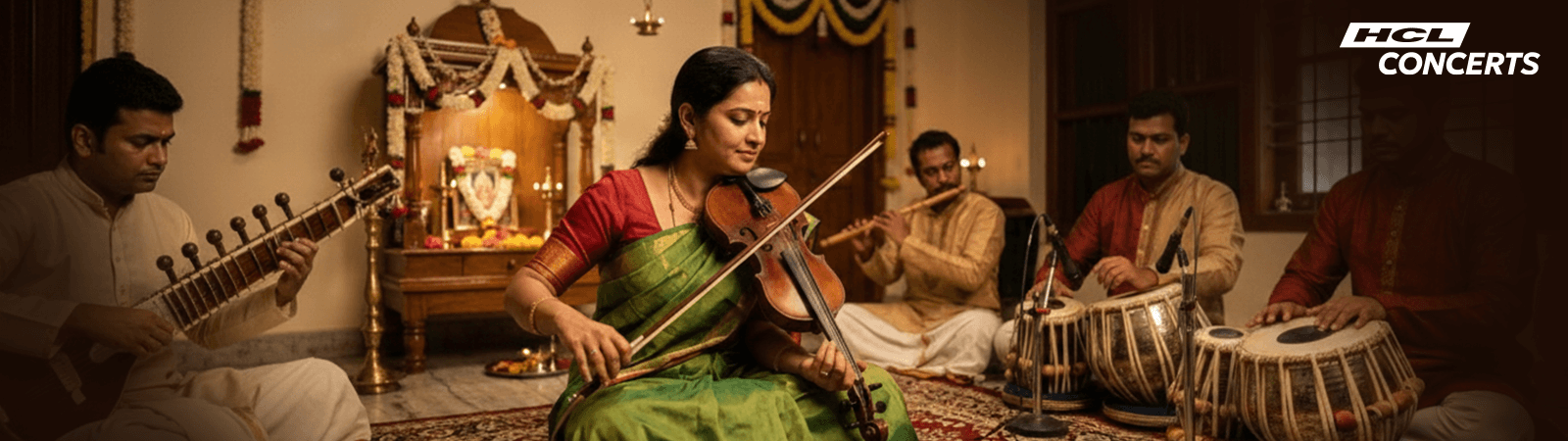
Attend a modern Carnatic concert, and you will notice how central the violin remains. It accompanies vocalists, performs solo segments, and engages in lively exchanges with percussionists. Audiences often look forward to violin solos during tani avartanam breaks or improvisational passages.
Many concerts now blend tradition with storytelling. Artists explain ragas, share anecdotes about composers, and interact with audiences. This makes performances more engaging, especially for first-time listeners.
Festivals and curated concert series are also creating immersive experiences. From intimate baithaks to grand auditoriums, the violin continues to captivate diverse audiences.
Cultural Significance of the Violin in Carnatic Music
Beyond its musical contributions, the Carnatic violin carries profound cultural meaning.
- Symbol of synthesis: Indian musicians have transformed the instrument, creating something neither purely Western nor traditionally Indian but authentically Carnatic.
- Preservation through adaptation: Ironically, the “foreign” violin has become a guardian of Carnatic tradition. Its close relationship with vocal music has encouraged precise preservation of raga structures, gamakas, and compositional forms.
- Bridge between generations: For families maintaining Carnatic music traditions, the violin often serves as an accessible entry point. Once hooked by the violin’s beauty, many develop a lifelong passion for Carnatic music.
Future of the Carnatic Violin
What lies ahead for this instrument that has already defied expectations? The future looks both rooted and radiant. Young musicians are embracing technology while staying true to tradition. Online learning platforms are making training accessible worldwide. Global collaborations are introducing Carnatic sounds to new audiences.
Educational initiatives and curated concert platforms are also nurturing appreciation among youth. When storytelling, visual elements, and digital outreach combine, classical traditions feel more relatable.
As long as there are listeners who seek depth and beauty, the Carnatic violin will continue to flourish. It will evolve, adapt, and inspire – just as it has for centuries.
Conclusion
The story of the Carnatic violin is far from complete. For over two centuries, it has evolved from curiosity to companion, from foreign instrument to cultural treasure.
At HCL Concerts, we celebrate this beautiful truth. Every Carnatic music performance featuring the violin is witnessing a living tradition in action. It’s hearing the past and future conversing through four strings and a bow. Experience and feel how the Carnatic violin illuminates, elevates, and touches your soul in ways that defy explanation.
Because some truths can only be sung or played on a violin that learned to speak with an Indian accent.