From Alaap to Taan: Journey of a Live Hindustani Music Performance
2026-03-25There’s a moment when, somewhere in the first fifteen minutes of a live performance of Hindustani music, the room goes completely still. Not quite the way a cinema goes quiet when the lights dim, but genuinely still. People stop fidgeting, phones slip into pockets, and even breathing seems to slow. The musician hasn’t played a single composed note yet. Still, they’re only exploring – testing a phrase, letting a note linger, pulling back, then leaning in again. And yet the audience is completely held.
That’s the extraordinary power of Hindustani classical music. Unlike most musical experiences you’re used to, this one doesn’t begin with a song. It begins with a conversation between a musician and a raga, a slow, wordless negotiation that gradually draws you in, deepens as it unfolds, and builds toward moments of intensity that feel genuinely earned. Every stage of the performance has a name, a purpose, and a specific emotional role.
Here’s exactly what that journey looks like – from the very first breath of the alaap to the last exhilarating taan.
Experiencing a Live Hindustani Music Performance
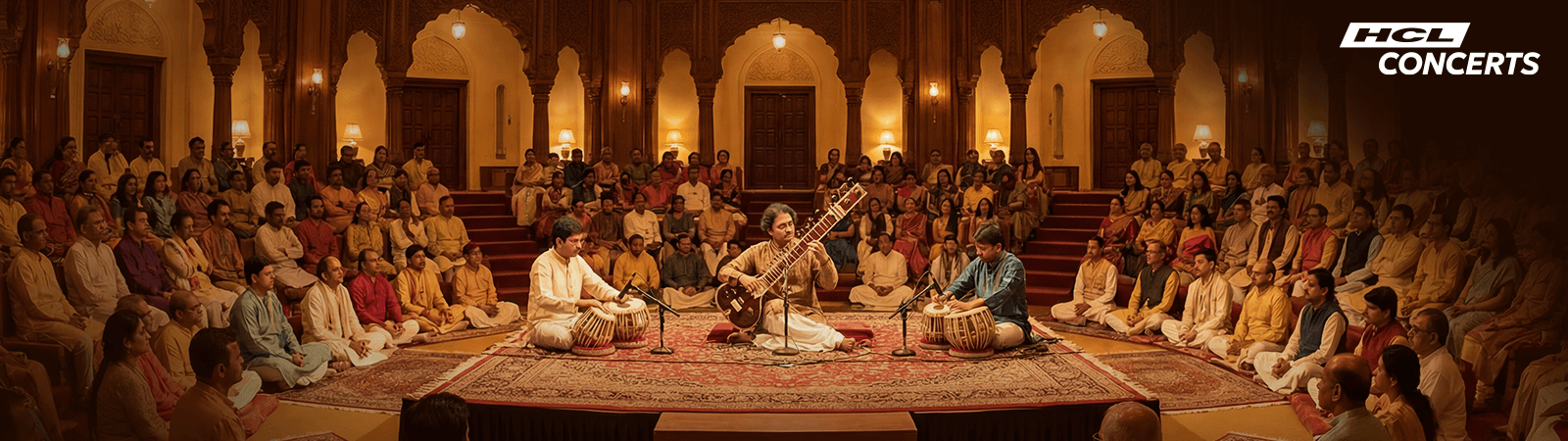
If you’ve never sat in the audience of an Indian classical music concert, the first thing to know is that it asks something of you and gives back far more in return. Walking into the venue, you’ll notice the atmosphere is already different from a pop concert or a theater show. The musician sits on a low stage, close to the audience, often at floor level.
As the performance begins, you quickly realise that time works differently here. A single raga can unfold over 45 minutes to two hours. And once you understand the arc of what’s happening, the stages a Hindustani musician moves through from beginning to end, the experience opens in ways that are genuinely hard to describe.
Understanding the Hindustani Classical Music Performance
Before you can fully appreciate what you’re hearing, it helps to understand the underlying architecture of a Hindustani performance. Every performance centers on a raga – a melodic framework built from a specific set of notes, each with its own character, emotional weight, and rules about how they relate to one another.
The musician doesn’t simply play a raga; they reveal it, layer by layer, across several distinct stages. These stages – alaap, jor, jhala, bandish, and taan – aren’t rigid sections with clear breaks between them. Understanding this progression is what transforms a concert from a beautiful but mysterious experience into something you can follow, feel, and genuinely understand.
Alaap: The Beginning of the Musical Journey
The alaap is where everything begins, and it begins with almost nothing. No rhythm, no percussion, no time signature. Just the musician and the raga. In this opening section, the artist introduces the raga one note at a time.
The musician might spend several minutes on a single note, examining every dimension of it before moving on. By the end of the alaap, you’ve been given the emotional landscape of the entire performance, even if you haven’t consciously registered it yet.
Jor: Introducing Rhythm and Movement
After the stillness of the alaap, something shifts. The music begins to move. The jor introduces a sense of pulse, not a fixed beat from the tabla, but an internal rhythmic momentum generated by the musicians themselves.
The raga’s emotional register deepens here. The musician begins to take slightly more risks; testing note combinations and introducing patterns that will become more elaborate as the performance builds.
Jhala: The Energetic Expansion
The jhala is where the energy breaks open. If the alaap was a slow dawn and the jor a brightening morning, the jhala is full daylight. The pace accelerates dramatically. On a sitar or sarod, the jhala involves rapid strumming on the chikari strings. This technique produces a bright, rhythmically intense sound that can feel almost percussive.
For a vocalist, this section involves faster, more ornate melodic patterns. The jhala generates excitement in a way that feels earned precisely because you’ve been patiently following the raga’s slower development.
Bandish or Composition: The Core of the Performance
The bandish is a composed piece – a short, structured song or instrumental composition set within the raga. For the first time in the performance, the tabla enters, establishing a rhythmic cycle (taal) that the musician and percussionist will navigate together.
The bandish gives the raga a concrete identity: a melody you can follow, lyrics (in vocal performances) that carry poetic meaning, and a rhythmic framework that creates a new kind of tension.
Taan: The Climactic Improvisation
The taan is the moment the entire performance has been building toward, and when it arrives, you feel it in your chest. Taans are rapid, cascading melodic runs executed at breathtaking speed. A skilled vocalist or instrumentalist will move through complex note patterns faster than you can consciously follow. Yet, every note lands precisely where it should.
The taans become progressively longer and more daring as the performance reaches its peak, with the musician and tabla player engaging in increasingly intense rhythmic dialogue.
Role of Instruments in a Live Performance
A Hindustani performance is never a solo act in the truest sense. Even when a single musician is at the center, a carefully chosen ensemble shapes everything you hear.
- Tanpura: It provides the continuous drone that underpins the entire performance. A four-stringed instrument tuned to the root notes of the raga, creating a harmonic foundation against which every melodic choice is measured.
- Tabla: When it enters the bandish, it transforms the performance’s dynamic entirely. A great tabla player converses with the main musician, responding to phrasing, anticipating shifts, and occasionally stealing the spotlight during percussive dialogues called laggi or tihais.
- Sarangi and Harmonium: They provide melodic accompaniment during the composed sections. Each instrument adds a layer of sonic depth and emotional texture that the lead musician’s sound alone cannot achieve.
The Journey of a Hindustani Classical Concert
What makes a Hindustani performance unlike almost any other musical experience is the way it changes you as it unfolds. You arrive as an audience member. By the alaap’s end, you’re a listener. By the jor, you’re anticipating phrases, feeling the pull of the raga’s logic. By the jhala, you’re invested in the musician’s choices in a way that feels almost personal. And by the time the taans begin, you’re not passively receiving music, you’re riding it.
The gradual development is the mechanism of this transformation. Hindustani music doesn’t rush to reward you; it builds the capacity for reward within you as it goes. Audiences who’ve experienced this arc often describe it as one of the most complete emotional journeys they’ve had through music.
Where to Experience Live Hindustani Classical Music Performances?
If this journey sounds like something you want to experience in person,
HCL Concerts’ curated music concerts are among the finest opportunities available in India today. It has been one of India’s most respected platforms for Indian classical music, bringing legendary vocalists and instrumentalists to audiences across the country in settings that honour both the music and the listening experience.
Their concerts feature performances by some of the most celebrated names in Hindustani music today, from master vocalists carrying forward the great gharana traditions to instrumentalists at the peak of their artistry. Whether you’re attending your first Indian classical music concert or you’ve been a devotee for decades, HCL Concerts creates an environment where the music can do exactly what it’s meant to do.