What Is Dhrupad? India’s Oldest Living Classical Music Form
2026-05-25Some music entertains; some music transforms the way we listen. But Dhrupad does something rare – it stills you! It is the oldest surviving form of Indian classical music, with roots stretching back over a thousand years, and yet it feels remarkably alive in every performance.
Unlike anything you might have heard before, Dhrupad does not rush to impress you. It arrives slowly, deliberately, like a tide coming in, and by the time it reaches full depth, something in the room has shifted. If you are curious about Hindustani classical music or want to understand what all the reverence around Dhrupad is about, this guide will walk you through everything, from its unique structure and ancient traditions to the musicians who have kept it burning through the centuries. Once you hear it properly, you will never forget it.
What Is Dhrupad?
A concert hall settles into silence before the first note is even sung. Two vocalists sit facing the audience, with nothing but the tanpura’s steady hum in the background. There is no dramatic opening, only a slow unfolding of sound; one note held with patience, another gently answering it, as though the music is revealing itself one breath at a time. The stillness in the room feels like everyone is waiting to be taken somewhere timeless.
This is Dhrupad singing, and what you are witnessing is not a warm-up. This is the performance! Dhrupad is a form of classical vocal music those dates back to the 15th century, with origins believed to be even older, rooted in the Vedic tradition of chanting Sanskrit hymns. It was the dominant form at the Mughal court before Khayal eventually rose to prominence, and it has been passed down through unbroken family lineages, or gharanas, ever since.
The word “Dhrupad” comes from “dhruva” (fixed or eternal) and “pada” (word or verse), and that gives you a clue about its character. It is grounded, serious, and deeply contemplative music.
What Makes Dhrupad Different from Other Classical Forms?
If you are familiar with Khayal, the more widely performed style of Hindustani classical music, Dhrupad is an older, more austere ancestor. Khayal is emotionally expressive and ornate and allows the singer to consider improvisational freedom within a relatively fast-moving structure. Dhrupad, by contrast, is slower, stricter, and far more meditative. Where Khayal might feel like a conversation, Dhrupad feels like a prayer.
The Four-Part Structure of Dhrupad: Sthayi, Antara, Sanchari, Abhog
A Dhrupad composition is built across four distinct sections, each one deepening the exploration of the raga.
- Sthayi: The opening section, built around the lower and middle notes of the raga.
- Antara: Moves into the higher register, expanding the emotional range of the composition.
- Sanchari: A roaming, exploratory section that moves freely across all three registers of the voice.
- Abhog: The closing section, which brings everything back together, often references the composer’s name (the chap) in the lyrics.
Alap: The Heart of Dhrupad Performance
Before any of those four sections begin, there is the Alap, where Dhrupad ragas are truly unveiled. The Alap has no rhythmic accompaniment, with no tabla, no pakhawaj, no beat of any kind. Just the voice, or voices, moving through the raga, note by note, phrase by phrase, in complete freedom of time. The singer might spend 20, 30, or even 45 minutes in the Alap before the rhythmic composition begins.
The Pakhawaj: Dhrupad’s Percussion Partner
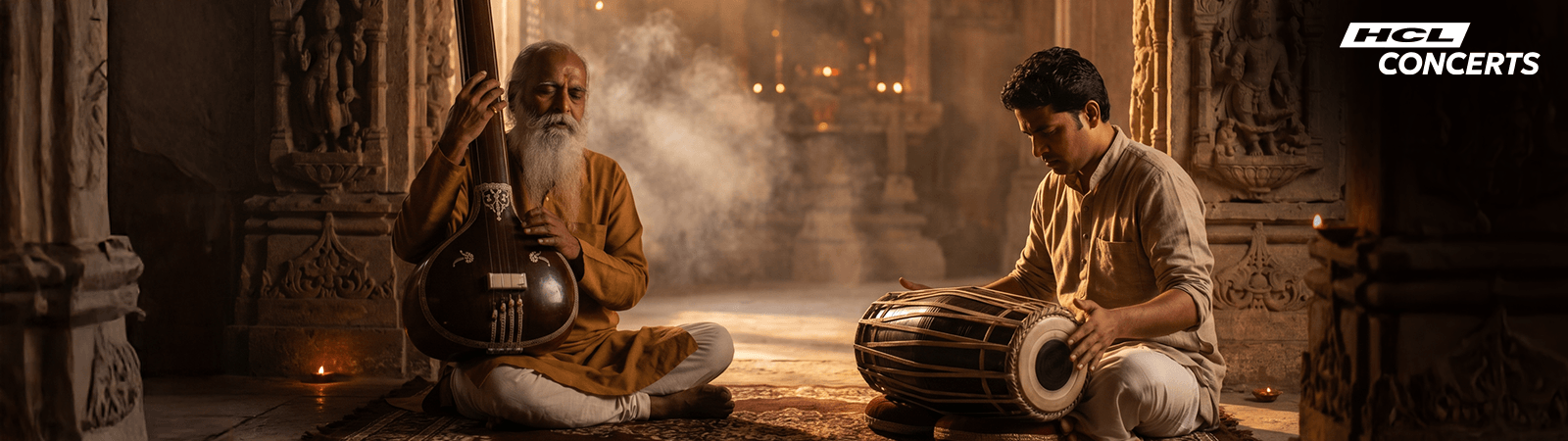
When rhythm does arrive in a Dhrupad performance, it comes via the pakhawaj – a barrel-shaped, double-headed drum quite different in character from the tabla that most people associate with Indian classical music. Where the tabla has a sharp, articulate sound that responds quickly to melodic phrasing, the pakhawaj has a deeper, rounder tone. It supports the voice rather than dialoguing with it, grounding the performance with a steady, ancient pulse that feels entirely in keeping with Dhrupad’s spiritual weight.
The Gharanas: Different Schools of Dhrupad
In Indian classical music, a gharana is a family tradition. Knowledge is passed from teacher to student across generations, often literally from parent to child, and each gharana develops its own distinct style, repertoire, and philosophy.
Dagar Gharana – The Most Widely Known
The Dagar gharana is the most prominent Dhrupad lineage of the 20th century, and its survival through a period when Dhrupad had been largely overshadowed by Khayal is largely thanks to the legendary Dagar Brothers: Ustad Nasir Moinuddin Dagar and Ustad Nasir Aminuddin Dagar. Their recordings and concert tours from the 1950s through the 1980s reintroduced Dhrupad to audiences in India and abroad and sparked a revival that continues today.
Other Gharanas: Talwandi, Betia, Vishnupur
Each of the other major gharanas brings its own flavour to the tradition:
- Talwandi Gharana: Known for a more aggressive, rhythmically vigorous style with complex pakhawaj interplay. Vocalists like Labrez Afzal Khan & Ali Hafeez Khan reflect the depth and strong rhythmic tradition associated with this style.
- Bettiah Gharana: Associated with a softer, more lyrical approach, with considerable emphasis on poetic text. Artists like Pandit Indra Kishore Mishra reflect the melodic finesse and expressive depth often associated with this nuanced style of classical performance.
- Vishnupur Gharana: From Bengal, this lineage has historically been more connected to devotional and temple contexts and is notable for preserving a distinctly regional character within the broader Dhrupad tradition. Artists like the Padma Shree Awardee, Pandit Manilal Nag, are often appreciated for bringing emotional expression and lyrical richness to classical performances.
What to listen to at a Dhrupad Concert?
Going to a Dhrupad concert for the first time can feel a little bewildering, especially if your musical frame of reference is something more immediately accessible. Here is a simple guide to help you actually hear what is happening.
The Slow Build of the Alap
The Alap is where most first-time listeners either connect with Dhrupad or lose the thread. The key is to let go of your expectation of melody in the conventional sense. Patience is not a performance choice; it is a philosophy.
Call and Response Between the Two Vocalists
Dhrupad is frequently performed as a duet, called jodi, and watching two singers navigate a raga together is one of its most compelling features. One singer might begin a phrase; the other continues it, answers it, or takes it somewhere unexpected.
Recognising the Raga as It Unfolds
Every Dhrupad raga has a signature, a cluster of characteristic notes and phrases that identify it, the way a face has features you learn to recognise. As the performance develops, listen to these recurring phrases. They will come back in slightly different forms and registers. That feeling of recognition is one of the quiet pleasures of classical vocal music at its most refined.
Famous Dhrupad Artists Every Classical Music Listener Should Know
If you want to explore Dhrupad singing through recordings or live concerts, these are the artists to start with:
- Ustad Wasifuddin Dagar: A leading exponent of the Dagarvani tradition, Ustad Wasifuddin Dagar carries forward one of the oldest and most respected lineages in Dhrupad. His performances are known for their meditative alap, precise control of the voice, and deep connection to the spiritual roots of Indian classical music.
- Umakant Gundecha: As one of the prominent voices behind the revival of Dhrupad in recent decades, Umakant Gundecha has helped expand its reach through performances, teaching, and workshops. His contribution has played a major role in making Dhrupad relevant to new generations of classical music listeners.
- Uday Bhawalkar: He is widely recognised for introducing Dhrupad to modern listeners across India and internationally. His ability to present this ancient style in a way that feels accessible to younger audiences has made him one of the most influential contemporary classical performers.
Conclusion
Dhrupad is not music that asks for your attention and then dazzles you. It invites you into stillness, rewards patience, and reveals itself slowly. Whether you are new to Hindustani classical music or a seasoned listener looking to go deeper, Dhrupad offers something no other form quite does. Explore upcoming Dhrupad performances and classical events at HCL Concerts, one of India’s most trusted platforms for celebrating the finest in classical music.