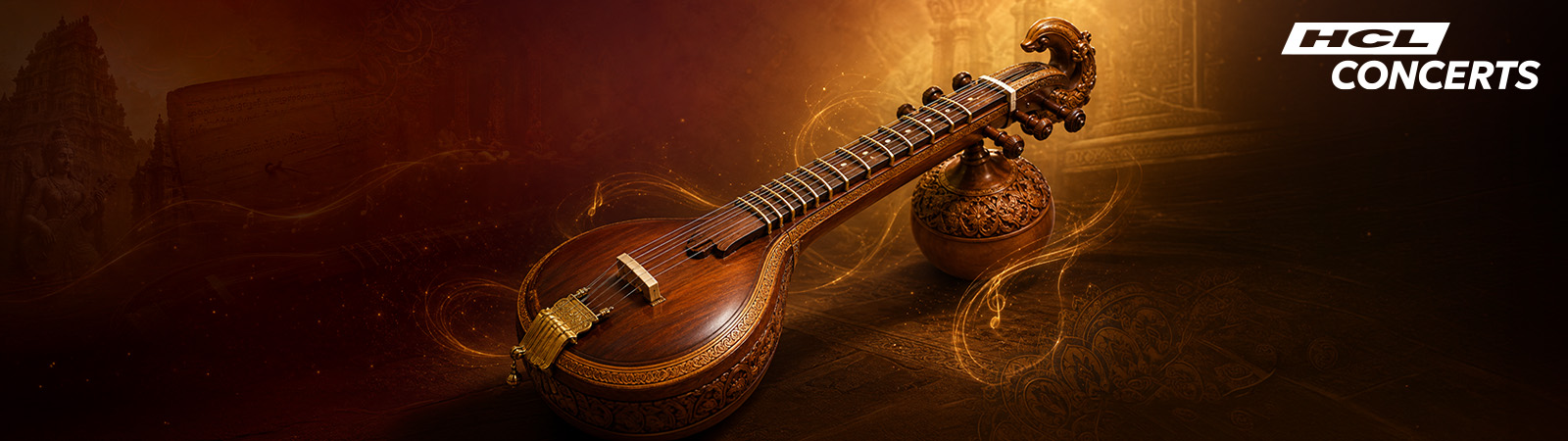
Veena in Carnatic Music: History & Significance
2026-08-10What Is the Veena?
If Carnatic music has a queen among its instruments, it is the veena. No other instrument is so tightly woven into the culture’s imagination: it rests in the hands of Saraswati, the goddess of learning, and has been revered for thousands of years as the very sound of wisdom. In simple terms, the veena is a large, plucked string instrument, central to Carnatic classical music .The player sits on the floor, cradling its long-fretted neck and rounded resonating body, and plucks the main strings while sliding along the frets to shape each note. Yet it is far more than a sacred symbol, capable of imitating the human voice so closely that, played well, you could almost mistake one for the other. Of all the Indian musical instruments, few demand such a complete union of hands, ears and patience, which is part of why it has always been held in such high esteem.
History of the Veena: Ancient Roots
The history of veena stretches back further than almost any instrument still played today, reaching deep into mythology and the earliest classical texts.
Vedic and Puranic Texts
The word “veena” appears in the very oldest layers of Indian literature. In the Vedic and Puranic texts, it is mentioned repeatedly as an instrument of the gods and sages, and above all, it became the emblem of Saraswati, the goddess of knowledge, music and the arts.
This sacred association gave the veena a status no other instrument quite shares. To play it was, in a sense, to touch the divine.
How the Veena Evolved Over Centuries
Of course, the veena of the ancient texts was not the instrument we see today. In early times, “veena” was almost a generic word for stringed instruments, and its forms changed continually. Gradually, through steady refinement of its frets, strings and resonators, it evolved into the Saraswati Veena, the fixed-fret, single-body instrument now synonymous with the Carnatic stage. This long history of veena development is really a story of countless small improvements.
Types of Veena in Indian Classical Music
Many listeners assume there is only one veena. In fact, the name covers a small family of related instruments found across the Indian musical instruments , and the differences matter.
The Saraswati Veena – The Carnatic Icon
The most celebrated of them is the Saraswati Veena, the instrument most people picture when they hear the word. Carved traditionally from a single block of jackwood, it has a large rounded gourd, a long neck bearing twenty-four fixed frets, and a set of playing and drone strings. It is this veena that dominates the Carnatic concert stage, prized for its deep, rounded tone and its extraordinary ability to sing.
Rudra Veena and Other Variants
The family does not end there. The Rudra Veena, a majestic stick-zither instrument with two large gourds, belongs chiefly to the Dhrupad tradition of Hindustani classical music in the north.
Other relatives include the Vichitra Veena and the Chitra Veena (or gottuvadhyam), each with its own voice.Together they show how a single ancient idea branched into distinct instruments across India’s two great classical systems.
The Veena’s Role in Carnatic Music
Within the southern tradition, the veena is not merely decorative, it is a complete musical instrument capable of expressing an entire raga alone. Its role rests on two great strengths: its command of ornament, and its power to teach.
How It Renders Gamakas (Ornaments)
Gamakas, the slides, oscillations and graces that give Carnatic music its emotional life, are the soul of the tradition, and the veena renders them superbly. By pulling a string sideways across a fret, a player can bend a single note through several pitches, gliding and shaking exactly as a singer would.This is why veena music can sound so vocal: the fretboard, rather than limiting the player, becomes the very tool that lets one note melt seamlessly into the next.
The Veena as a Teaching Instrument
The veena is also a great teacher. Many Carnatic musicians, including vocalists, begin their training on it because playing the instrument makes the structure of a raga visible and physical. Finding each note by hand and shaping each gamaka with the fingers builds a deep, embodied understanding of how ragas actually work.
Mastering the Instrument: The Journey of Learning the Veena
Few instruments ask as much of a student as the veena. Learning it is a slow, patient apprenticeship rather than a quick skill. In the early months, a beginner works simply on posture and touch, how to sit, how to cradle the instrument, and how to pluck a clean note without the strings buzzing. Only then does the real work begin: training the left hand to press and pull the strings across the frets, which is what gives the veena its singing quality.The greatest challenge is the gamaka; bending a single note through several pitches, smoothly and in tune, takes years of daily practice to master. Traditionally, this journey unfolds under a guru, note by note, in the time-honoured oral tradition, and alongside the physical technique, a serious student absorbs the theory of ragas and talas so that hands and mind grow together. It is demanding, unhurried work, but it is exactly this devotion that lets a mature artist make the instrument seem to breathe.
Legendary Veena Artists and Their Legacy
An instrument lives through its players, and the veena has been served by some truly great ones. A handful of veena artists, in particular, defined how it is heard today.
Veenai Dhanammal, S. Balachander, Emani Sankara Sastry, Dr. Jayanthi Kumaresh
Veenai Dhanammal (1867–1938) set the gold standard with her austere, deeply meditative style, playing without a plectrum and often singing along. S. Balachander (1927–1990) was a bold, individual genius who thrilled audiences through concerts and recordings. Emani Sankara Sastry (1922–1987) brought a scholarly depth and, through All India Radio, carried the instrument to a national audience. And today, Dr. Jayanthi Kumaresh, recently honoured with the Sangita Kalanidhi, continues to champion the veena on the world’s stages.
How These Artists Shaped the Veena’s Concert Reputation
Between them, these veena artists transformed the instrument’s public life. What had long been associated with temple ritual and private recitals, they carried firmly onto the modern concert platform, proving the veena could hold a large hall entirely on its own. Their recordings, radio broadcasts and international tours turned a sacred emblem into a celebrated solo concert instrument and secured the veena music we still cherish today.
Conclusion
For all its ancient roots, the veena is anything but a museum piece. It is still taught to eager beginners, still performed on the great Carnatic stages, and still quietly evolving in the hands of a new generation. Among the Indian musical instruments, it remains uniquely poised between the sacred and the artistic: the goddess’s instrument, yes, but also a living voice that continues to sing, string by string, into the present.