Understanding Tala in Hindustani Classical Music: Rhythm and Cycles
2026-11-16Tala is the rhythmic framework of Indian classical music, with deep roots. The Natyashastra, attributed to Bharata Muni, treats rhythm and time as integral to performance. Sharngadeva’s thirteenth-century treatise, the Sangita Ratnakara, describes a detailed system of talas that later musicians built upon.
For centuries, the pakhawaj, a two-headed barrel drum, accompanied dhrupad and set the rhythm in temples and courts. In the eighteenth century, as khayal grew in popularity, the tabla rose alongside it. Its lighter, more versatile sound suited the new vocal style. Tabla gharanas soon emerged in Delhi, Ajrada, Lucknow, Farukhabad, Benares and Punjab, each with its own approach to rhythm.
Today, tala in Hindustani music works as a repeating cycle of beats that gives every performance its structure. Singers and instrumentalists improvise over it; the tabla player keeps it steady, and experienced listeners follow it with their hands. Here we break down how tala works, look at the most common cycles, and share practical tips for recognising them.
Understanding the Tala System
To understand rhythm in Hindustani classical music, it helps to start with three basic ideas: matra, vibhag, and sam. Together, they give a tala its structure, much like bars and beats help organise rhythm in Western music. A tala is not simply a fixed number of beats, however. Its character also comes from how those beats are grouped, where the emphasis falls, and how musicians interact with the cycle during a performance.
Matra, Vibhag, and Sam: The Building Blocks
- Matra: The individual beat
- Vibhag: A group of matras within the cycle
- Sam: The first and most important point of the cycle
Matra: The Individual Beat. A matra is the basic time unit within a tala. It is commonly described as a beat, and the total number of matras determines the length of a tala cycle. For example, Teentaal has 16 matras, while other talas may have 6, 7, 10, 12 or 14, among other structures. So, if a tala has 16 matras, the musician is working within a 16-beat cycle. The cycle keeps moving continuously until it returns to its starting point.
Vibhag: Grouping the Beats. If matras are individual beats, vibhags are the sections into which those beats are organised. A vibhag can contain two, three, four or more matras, depending on the tala. For instance, Teentaal’s 16 matras are divided into four vibhags of four matras each. This grouping makes the cycle easier to follow and gives it a recognisable rhythmic shape.
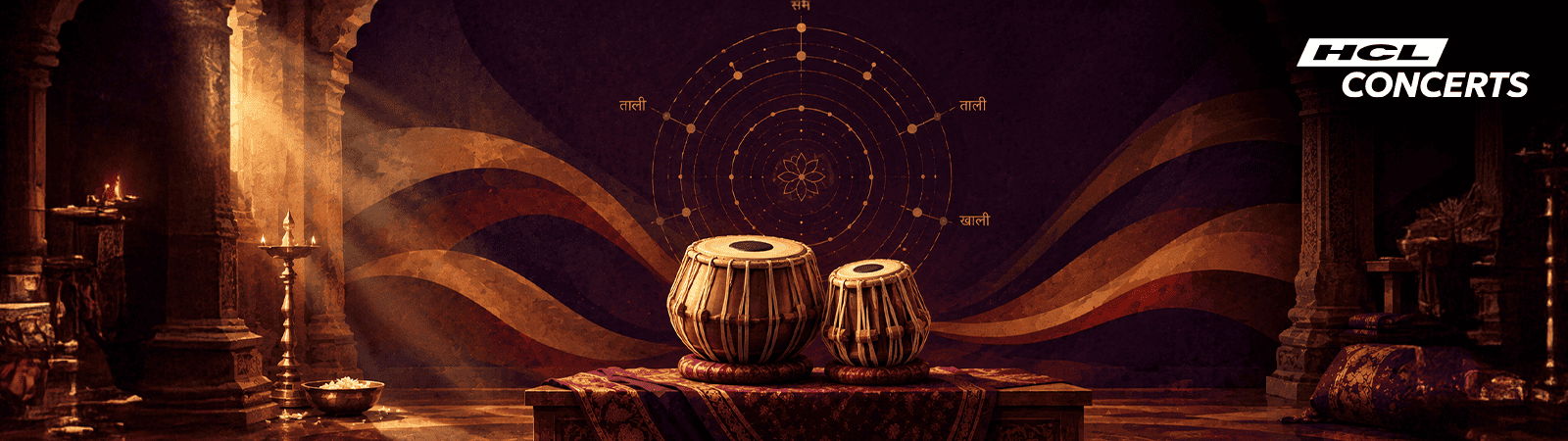
Sam: The Point Everything Returns To. The sam is the first beat of the tala cycle and one of its most important points. It is where the rhythmic cycle begins and where it eventually returns. Because of this, sam carries a strong sense of arrival and resolution. The sam is generally shown with an asterisk (*) in tala notation, while khaali may be represented by 0. Examples of tala structures show the sam placed on the first beat of the cycle, with taali and khaali marking other important points.
Tala in Music: How Cycles Give Structure
Tala in music is not only a Hindustani idea. Carnatic music has its own detailed tala system, and Western music uses repeating metres such as the three-beat waltz. The Hindustani approach stands out for its long cycles and the freedom it gives performers to improvise across them.
How a Rhythmic Cycle Repeats and Resolves
The tala repeats continuously. A singer might stretch a phrase across several cycles, then return precisely to sam. Musicians often use a tihai, a phrase repeated three times, to land on sam. Audiences typically react at that arrival.
Common Talas in Hindustani Music
A small group of talas covers most of what you will hear in concerts.
Teentaal: The Sixteen-Beat Cycle
Teentaal is the most widely used tala in Hindustani vocal and instrumental music. It has sixteen beats divided into four vibhags of four.
Dha Dhin Dhin Dha | Dha Dhin Dhin Dha | Dha Tin Tin Ta | Ta Dhin Dhin Dha
Claps fall on beats 1, 5 and 13. Beat 9 is the khaali, where the tabla drops its bass strokes. Teental works at almost any tempo. The well-known bandish Albela Sajan Aayo Ri in Raag Ahir Bhairav, familiar to many from Hum Dil De Chuke Sanam, is traditionally set in teental. Many tabla solos and sitar gats also use teental.
Ektaal: The Twelve-Beat Cycle
Ektaal has twelve beats in six vibhags of two.
Dhin Dhin | Dha Ge Tirakita | Tu Na | Kat Ta | Dha Ge Tirakita | Dhi Na
Claps fall on beats 1, 5, 9, and 11, with waves on 3 and 7. Ektaal is a favourite for vilambit (slow) khayal, where one cycle can last close to a minute. Pt. Bhimsen Joshi and many Kirana gharana singers performed slow khayals in ektaal. At fast speeds, drut ektaal is often used for taranas, showing how versatile ektaal is. You can find Ektaal in famous Bollywood songs like Jago Re Jago Prabhat Aya and Main Radha Teri Meri Shyam Tu.
Other Talas Used in Vocal and Instrumental Music
- Jhaptaal (10 beats, 2+3+2+3): Asymmetrical and lilting. Man Mohana Bade Jhoothe from the film Seema is a well-known example.
- Rupak (7 beats, 3+2+2): Its sam falls on a khaali, so it begins with a wave.
- Keherwa (8 beats) and Dadra (6 beats): Lighter talas used in bhajans, ghazals and most film songs.
- Chautaal and Dhamar: Used mainly for dhrupad and played on the pakhawaj.
The Relationship Between Tala and Laya (Tempo)
Tala is a cycle, and laya is the tempo. The same teental can move at vilambit (slow), madhya (medium) or drut (fast) laya. A khayal performance often begins slowly and speeds up over time, while the tala itself stays the same. Musicians also play with layakari, fitting two, three or four notes into each beat to create rhythmic variety without changing the cycle.
How Musicians and Listeners Follow Tala in a Live Performance
The tabla player keeps time by playing the theka and emphasising sam. This steady base lets the soloist move away from the obvious beat without losing the audience. Soloists and accompanists often exchange glances as they approach sam. Listeners follow along too, with experienced audiences clapping on taali and waving on khaali. When the soloist and tabla land together on sam after a complex passage, you will often hear appreciative calls of “wah” from the hall.
Learning to Recognise Tala as a Beginner
- Start with teental: Play a medium-tempo recording and count to sixteen.
- Find the khaali: In teental, beat 9 sounds lighter. Use it as a marker.
- Use your hands: Clap on 1, 5 and 13, and wave on 9.
- Choose medium tempo first: Slow cycles are harder to count.
- Watch performers: Nods and smiles often signal sam.
- Accept mistakes: If you lose count, wait for the next strong “Dha” and restart.
Conclusion
Tala is the framework that gives Hindustani classical music its shape and momentum. Once you can follow teental or ektaal, concerts become far more rewarding. HCL Concerts is dedicated to making that experience available to everyone. Through Baithak, Soundscapes, and The Raaga Collective, HCL Concerts presents vocalists, instrumentalists, and tabla artists to listeners worldwide. Tune in to a Baithak session and try counting the cycle for yourself.