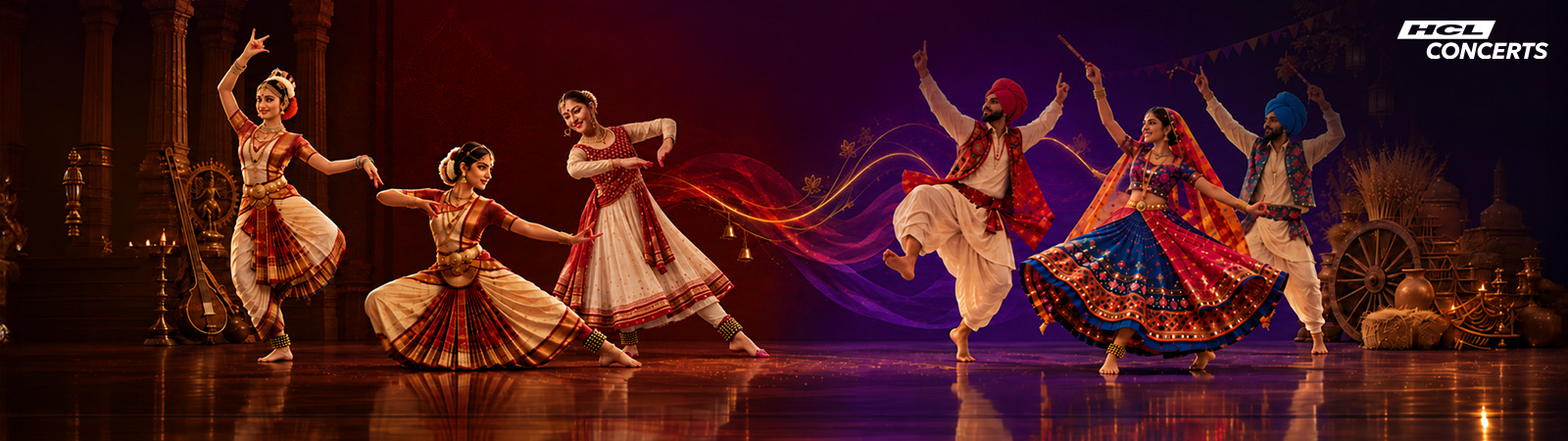
Classical Dance vs Folk Dance: Key Differences in India’s Dance Traditions
2026-09-23We often think of dance as movement set to music. But in Bharatanatyam, even the smallest gesture can carry meaning. A raised eyebrow, a turn of the hand, or a single glance can become part of a story, showing how Indian classical dance can communicate emotions and narrative without relying on words. That’s what makes India’s classical dance heritage so fascinating. Across the country, dance has always been closely tied to how people live, celebrate, worship, and tell stories. Some Indian dance forms grew in temples and royal courts, while others belong to the community celebrations like harvests, weddings, festivals and village gatherings.
Classical dance is shaped by technique, rhythm, and expression, while Indian folk dance often feels spontaneous, communal, and deeply rooted in regional traditions. From Bharatanatyam and Kathak to Bhangra, Garba and Ghoomar, these Indian traditional dances reflect the places and communities that gave them life. Let’s explore India’s classical and folk-dance forms, what makes each style unique, and the stories, traditions, and cultures behind some of its most famous dance forms.
Dance Forms in India
Travel from Kashmir to Kanyakumari, and you’ll find dozens of movement styles, each with its own rhythm, costume, story and reason for existing.
The Two Broad Categories: Classical and Folk
Broadly, every Indian dance form sits in one of two camps. Classical dance is codified, trained, and rooted in ancient texts. Folk dance grows out of everyday community life. One takes a decade of structuring and discipline under a guru; the other is often absorbed simply by growing up in a particular village and community.
Why India Has So Many Distinct Dance Styles
This variety isn’t just an accident of geography; India’s sheer regional diversity – different languages, deities, harvests, and histories almost every few hundred kilometres – has produced dance forms that look nothing alike yet share the same root instinct.
What Is Classical Dance?
Classical dance is a formally recognised set of styles, each governed by strict technique and centuries of codified grammar. Nothing about it is improvised.
Roots in the Natya Shastra and Temple Tradition
Most scholarship traces this grammar back to the Natya Shastra, the treatise on dramatic arts attributed to the sage Bharata Muni, believed to have been composed somewhere between 200 BCE and 200 CE. It set down rules for movement, expression and rasa, which is the emotion a performance is meant to evoke, that dancers still follow, almost unchanged, today. Many classical forms also grew up inside temples, performed as devotion rather than entertainment, which is part of why an Indian dance form like Odissi still carries that quiet, sculptural gravity even under stage lights.
The Nine Recognised Classical Dance Forms
Nine styles hold official classical status:
- Bharatanatyam from Tamil Nadu, all precision and fire;
- Kathak from the north, built on spins and footwork that tells a story;
- Kathakali from Kerala, unmistakable for its elaborate make-up and mythological plots;
- Kuchipudi from Andhra Pradesh, lighter and more dramatic in tone;
- Odissi from Odisha, lyrical and sculptural;
- Manipuri from the Manipur, gentle and devotional;
- Mohiniyattam, Kerala’s “dance of the enchantress”;
- Sattriya, which grew out of Assam’s monasteries;
- Chhau, from eastern India, known for its energetic masked dances, martial movements, and mythological storytelling.
What Is Folk Dance?
Folk dance runs on the opposite instinct – less about technique, more about simply joining in.
Folk Dance of India: A Regional Tradition
Every state carries its own folk dance in India, shaped by local festivals, harvest cycles, weddings and daily life rather than any written manual. Nobody trains for years to take part. You learn by watching your neighbours and stepping into the circle.
Examples Across India’s States
Each folk dance is an expressive dance built for a crowd, not a proscenium stage. A handful worth knowing:
- Bhangra and Gidda in Punjab, loud and unrestrained at harvest time;
- Garba in Gujarat, circular and devotional through Navratri;
- Bihu in Assam, welcoming the spring;
- Lavani in Maharashtra, sharp-rhythmed and theatrical.
Key Differences Between Classical and Folk Dance
Classical and folk dance may share the same cultural roots, but they differ in how they are learned, performed and passed down through generations. Classical forms tend to follow established techniques, movements and storytelling traditions, while regional customs, celebrations, and community life often shape folk dances. Looking at these differences makes it easier to understand what gives each style its own character.
Origins, Training, and Technique
Classical dance is codified and slow to master. A Bharatanatyam or Kathak dancer often spends a decade or more training under a guru before performing solo, learning fixed postures, hand gestures (mudras) and rhythmic cycles down to the last beat. Folk dance is learned informally, passed down within families and communities with no fixed syllabus. There is no wrong way to dance Bhangra at a wedding, and that’s the entire point of folk dances.
Costumes, Music, and Performance Setting
Classical performances use form-specific costumes, such as the pleated fan skirt of Bharatanatyam and Kathakali’s towering headgear, which are paired with classical music, usually live vocalists and instruments like the mridangam or tabla. Folk dance leans on regional dress and local instruments: dhols, manjeeras, sometimes nothing more than handclaps and voice. One happens under stage lights in an auditorium; the other happens in a courtyard, a field, or the middle of a street during a festival.
Purpose: Storytelling and Devotion vs Celebration
Classical dance narrates myth and devotion through abhinaya, the art of expression – a single Bharatanatyam performance might retell an episode from the Ramayana using only the face and hands. Folk dance rarely narrates anything; it celebrates and marks a harvest, a wedding, a change of season, and more of a community life. Neither purpose outranks the other; they’re simply answering different questions about why we dance.
Famous Dance Forms of India: Classical and Folk Examples
Classical and folk dance were never meant to sit on a ladder; one ranked above the other. One trains the body for years to whisper a myth through a single glance, while the other pulls an entire village into a circle within seconds. India has kept both alive, side by side, and that’s worth celebrating rather than ranking. Reading about it only gets you so far, though.
Why India’s Dance Styles Matter Today
Both traditions are thoroughly alive, not relics behind glass. Classical dance schools across Indian cities enrol students by the hundreds every year, and folk dance shows no sign of slowing down at weddings, festivals or college fests.
Preserving the Cultural Dance of India in the Modern Era
Government cultural bodies, university departments, and increasingly Instagram and YouTube are all doing their part to keep India’s cultural dance visible to younger audiences. Concert platforms and cultural festivals continue to host classical recitals and folk troupes’ side by side, which says something rather lovely about where things stand; neither needs the other’s permission to matter.
HCL Concerts has been promoting and preserving the artforms for around 3 decades now. It brings classical dance and music to stages throughout the year, so you can watch an abhinaya unfold or feel a rhythmic cycle build in the room, not on a screen. Look at our upcoming shows and see India’s dance heritage the way it was always meant to be experienced – live and up close.