Ghazal Music for Beginners: The Poetry Behind the Melody
2026-10-21Have you ever listened to a ghazal and found yourself paying more attention to a particular line than to the music around it? You may not even know exactly why it stayed with you; perhaps it was about love, someone leaving, missing or just waiting for someone, that oddly familiar feeling of wanting something you cannot quite put into words. That is often where the magic of ghazal music lies – the melody draws you in, but the words give you a reason to keep listening.
Ghazal poetry has a way of saying a lot without saying everything outright. A ghazal poet can take something as ordinary as longing or heartbreak and turn it into a line that feels deeply personal. The ghazal singer gives those words their own rhythm, pauses, and emotion. The result is a ghazal song that can mean something different to everyone who hears it.
Let’s explore what makes ghazal music so special, how its poetry works, and the role of ghazal poets and singers in keeping this beautiful tradition alive.
What Is Ghazal Music?
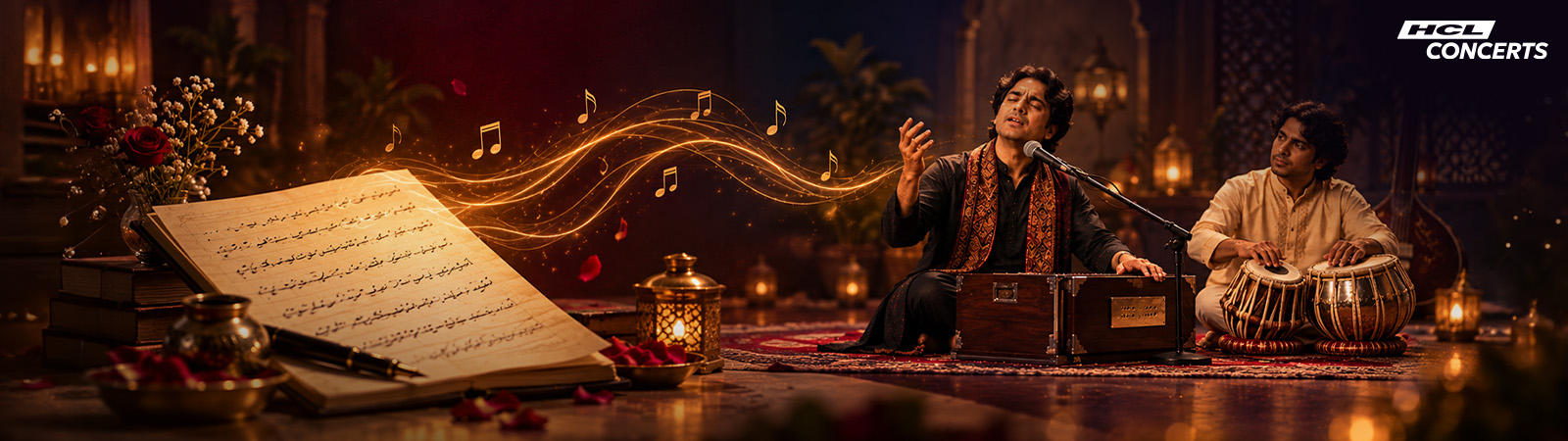
A ghazal is a poetic form that has been part of South Asian culture for centuries. A ghazal may sound gentle and simple at first, but listen closely, and you’ll often hear a lot happening beneath the surface. You will often hear the voice accompanied by instruments such as the harmonium and tabla, with the sitar sometimes adding another layer. The singer uses pauses, pitch changes, and subtle vocal expressions to bring out the feeling behind each verse.
Much of this tradition comes from the rich Persian and Urdu literary heritage. This blend of thoughtful poetry and expressive singing has allowed ghazal music to stay relevant and loved across generations.
A Song Built on Poetry, Not the Other Way Around
This is the reverse of how most film songs or pop music work, where a tune usually comes first, and lyrics get fitted around it. Ghazal music flips that order: the poem stands complete on its own, and the melody is an act of interpretation layered on top, decades or centuries after the ink dried.
Why Beginners Find Ghazal Music Rewarding to Learn
A ghazal doesn’t ask for your full attention-span the way a forty-minute raga rendition might. It’s built from short, self-contained couplets, so you can dip in, sit with one line, and come back later without losing the thread. That makes ghazal music oddly indulging for beginners, and you’re never lost for long.
Understanding Ghazal Poetry: The Foundation of Every Ghazal Song
Before there’s a ghazal song, there’s a poem on a page, usually written in Urdu or Persian, though there are plenty of ghazals that have since been composed in Hindi. If you skip poetry, you’ll only get half the experience.
The Sher: A Complete Thought in Two Lines
“Hazaaron khwahishein aisi ki har khwahish pe dam nikle
Bahut nikle mere armaan lekin phir bhi kam nikle”
~ Mirza Ghalib
The basic unit of a ghazal is the sher – a couplet that stands as a complete thought in just two lines. A full ghazal might string together five, seven or more of these couplets, but crucially, each sher works on its own. You don’t need the whole poem to understand one; a good sher lands like a small, sharp truth, then lets you sit with it before moving to the next.
Radif and Qafiya: The Rhyme That Ties It All Together
Two Urdu terms hold the whole structure together: the radif, a refrain word or phrase repeated at the end of the second line of every sher, and the qafiya, the rhyme that comes just before it.
The radif is like an anchor the poet keeps returning to, and the qafiya is the word that has to rhyme each time freshly while still landing on that same anchor. It sounds technical when written out like this but listen to a handful of ghazals back-to-back, and your ear picks up the pattern within minutes. For example:
“Gulshan-e-yaad mein gar aaj bhi tanhaai hai
Dil ki duniya mein teri yaad hi reh jaati hai”
~ Faiz Ahmed Faiz
Radif: hai
Qafiya: tanhaai, jaati
Who Writes a Ghazal? The Role of the Ghazal Poet
A ghazal poet works within a strict form but has enormous freedom inside it. Each couplet can leap to a new subject entirely, from love to loss to mild political defiance, provided radif and qafiya hold.
Legendary Ghazal Poets Every Beginner Should Know
Mir Taqi Mir, often called the father of the modern ghazal, wrote with a plainness that still cuts deep. His lines read like overheard confessions rather than performed poetry. Mirza Ghalib came a generation later and pushed the form toward philosophy and wit, layering meaning until a single couplet could be read in three different ways. Between the two of them, you have most of what defines the ghazal as we know it today.
From Page to Stage: How Ghazal Singing Brings Poetry to Life
A written ghazal is a script, and singing ghazal is a performance. The gap between the two is where a lot of magic happens.
What Makes a Great Ghazal Singer
A ghazal singer doesn’t get to change the words, so the artistry lies entirely in interpretation: which syllable to stretch, where to pause, how much weight to put on a particular word the second time it’s sung. The same sher can sound resigned in one singer’s hands and defiant in another’s, purely through phrasing.
The Mehfil: Where Ghazal Singing Traditionally Happens
Ghazals were traditionally performed in a mehfil – an intimate gathering, often seated, with none of the distance a large concert hall creates. The singer could see the audience’s faces and respond to a murmur of appreciation after a particularly good line, which is part of why ghazal singing still feels conversational even now, decades after the mehfil moved onto bigger stages.
How to Listen to a Ghazal Song as a Beginner
A ghazal is not a song you need to understand all at once. Its beauty often lies in the words, the pauses, the melody and the emotions woven between them. As a beginner, listening with a little attention to each of these elements can make the experience much richer. Start by listening to the ghazal once without trying to understand every word. Then, listen again and notice the poetry, the repeated phrases, the singer’s voice and how the melody brings each sher to life.
Listening for Meaning Before Melody
Pick one sher, and read a translation if the Urdu is unfamiliar; then sit with what it’s actually saying before you let the melody carry you anywhere. Once the meaning is in place, go back and listen to how the singer handles that exact line – you’ll hear choices you missed the first time round.
A Beginner’s Starter Playlist of Ghazal Songs
Listen to Jagjit Singh’s rendition of “Hoshwalon Ko Khabar Kya,” Begum Akhtar’s classic interpretations of Ghalib, and Mehdi Hassan’s “Ranjish Hi Sahi” for a masterclass in restraint. None of this demands prior knowledge; all they ask of you is to slow down for a few minutes.
Getting Started: Where Beginners Can Explore Ghazal Music
Live concerts remain the richest way in, and nothing quite matches hearing a ghazal performed a few feet away. Recorded albums and lyric sites with translations are the next best thing, letting you build familiarity with the poets and their favourite themes before you walk into a mehfil-style evening yourself.
A ghazal’s tune is generous, the mood is unmistakable, but the real reward sits in the words underneath, waiting for anyone patient enough to read them properly. Once you start listening that way, you don’t really go back. Browse HCL Concerts’ upcoming events and let a live rendition show you what a recording never quite can.