The Importance of Riyaz in Hindustani Music
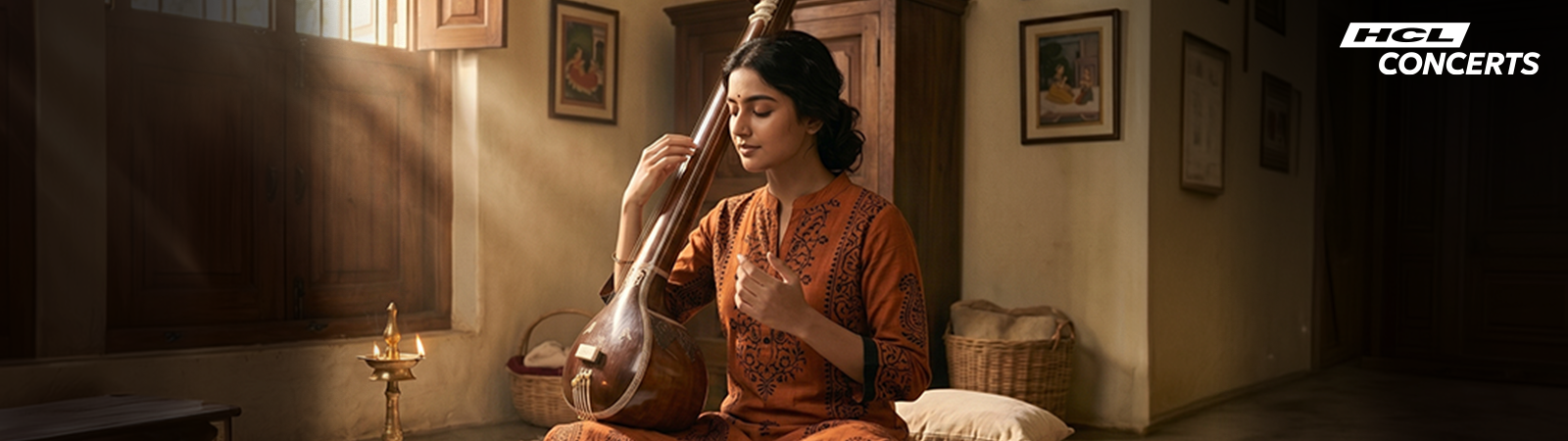
2026-07-20Picture a single lamp burning before dawn. A musician sits cross-legged, eyes closed, drawing out one long, unbroken note while the house still sleeps. No audience, no applause, no recording, only the note, the breath behind it, and the silence it fills. This is Riyaz, the daily practice that quietly underpins every great performance in Hindustani music. Long before a raga reaches a stage, it is born here, in these solitary early hours. For anyone serious about North Indian classical music, Riyaz is not just one part of music training; it is the part from which everything else grows.
Why Riyaz Is the Foundation of Hindustani Music
Talent might open the door, but Riyaz carries a musician through. Everything that wows an audience from gliding smoothly between notes to holding a note without running out of breath, sensing where a raga wants to go is built slowly by practising the same things over and over. In Hindustani music, Riyaz isn’t a task you finish; it’s the ground everything else grows from.
Building Voice Control and Breath Stability
Begin with the basics: control. A vocalist’s first job is to hold a note steady without wavering, for as long as the breath allows. Through Riyaz, sustained notes lengthen, pitch grows accurate, and the voice gains the stamina to carry a long performance without tiring. Breath becomes something the musician shapes rather than chases, earned slowly, one patient morning at a time, until steadiness becomes second nature.
Internalising Ragas Through Repetition
Crucially, Riyaz is not about memorising songs. It is about absorbing the grammar of a Hindustani raga until it lives in the body. Each raga has its own rules: which notes to dwell on, which to touch lightly and which phrases give it character. Repeated daily over months and years, those rules stop being something you remember and become something you feel. The mature musician doesn’t think their way through a raga; they inhabit it, because Riyaz has made its logic instinctive.
The Guru-Shishya Tradition and Daily Riyaz
For centuries, North Indian classical music has been passed down through the guru-shishya parampara, the bond between teacher and student. Within this relationship, Riyaz is never generic. The guru observes, diagnoses and prescribes, treating the student’s practice as personalised music training rather than a fixed routine handed to everyone alike.
How a Guru Shapes a Student’s Riyaz Routine
A good guru tailors Riyaz to the individual. They listen to the natural range and texture of a student’s voice, gauge their stage of development, and shape the schedule accordingly. A beginner might spend weeks on a single exercise; a more advanced student might be pushed towards demanding passages. What to practise, how long, and in what order are all decisions the teacher makes, adjusting as the student grows.
Riyaz as a Daily Discipline, Not a Goal
Perhaps the most important lesson is a shift in mindset. Daily Riyaz is not a box to tick or a level to clear; it is a lifelong discipline with no finish line. Even celebrated maestros practise every single day, because the moment you stop, the edge begins to dull. Riyaz is something you do, not something you complete; the practice itself, repeated faithfully, is the achievement.
What a Typical Riyaz Session Looks Like
So what actually happens in those early-morning hours? While every routine differs, most sessions follow a recognisable arc from gentle warm-ups to focused, demanding work. Much of it doubles as voice training, steadily conditioning the instrument before any real exploration begins.
Warming Up: Sa Re Ga Ma and Long Notes
A session almost always opens gently. The musician settles on the tonic, Sa, and holds long, steady notes to centre the voice and the breath. From there come the swaras Sa Re Ga Ma Pa Dha Ni sung slowly up and down the scale. For the Hindustani vocal student, these simple patterns are everything: they tune the ear, align pitch, and prepare the body for the harder work ahead.
Working Through a Raga Systematically
With the voice warmed, attention turns to a chosen Hindustani raga. The musician builds it patiently, note by note, then phrase by phrase, exploring how each swara behaves and how the characteristic movements fit together. Rather than racing to perform the whole thing, they linger, testing one phrase a dozen ways until it sits correctly. This unhurried, systematic building is how a raga is truly learned.
Taan and Layakari Practice
Finally come the athletic elements. Taans are fast, intricate runs of notes that are drilled for speed, clarity and accuracy. Layakari, the play of rhythm against the beat, is practised separately so melody and timing can each be sharpened before being woven together. These passages demand real stamina, which is why the earlier warm-up mattered.
How Riyaz Differs Across Instruments and Voice
It is easy to assume Riyaz belongs to singers alone, but instrumentalists are just as bound to it. A sitar, sarod or bansuri player rises at the same early hour and practises with the same devotion. The discipline is shared; only the mechanics differ.
Vocal Riyaz vs Instrumental Riyaz
The clearest contrast is physical. The Hindustani vocal musician’s Riyaz is breath-based; everything depends on air, control and the body itself as the instrument, which is why voice training sits at its core. Instrumental Riyaz is finger-based or bow-based: the sitarist drills fingerwork across the frets, the flautist refines breath and finger coordination. Yet the aim is identical to make the technique so automatic that the music flows freely.
The Mental and Spiritual Side of Riyaz
Strip away the technique, though, and something deeper remains. For many musicians, Riyaz is far more than skill-building. The repetition, the early hour, and the solitude together create a state of focus that feels closer to contemplation than exercise.
Riyaz as a Form of Meditation
Ask many practitioners, and they describe their pre-dawn practice as a spiritual ritual rather than mere training. The mind quietens. The outside world falls away. Holding a single note, fully present, becomes a kind of meditation, and the music turns inward. In this sense, Riyaz nourishes not only the voice but the musician’s inner life, one reason the tradition treats it with near reverence.
Conclusion
In the end, Riyaz is the line that separates the hobbyist from the serious artist. Anyone can sing a tune; only sustained, daily Riyaz turns raw ability into mastery. It is humbling precisely because it never ends; there is always another note to steady, another phrase to refine. That endless, patient pursuit is the very heart of Hindustani music, and it is why, somewhere right now, a lamp is burning, and a musician is beginning again.