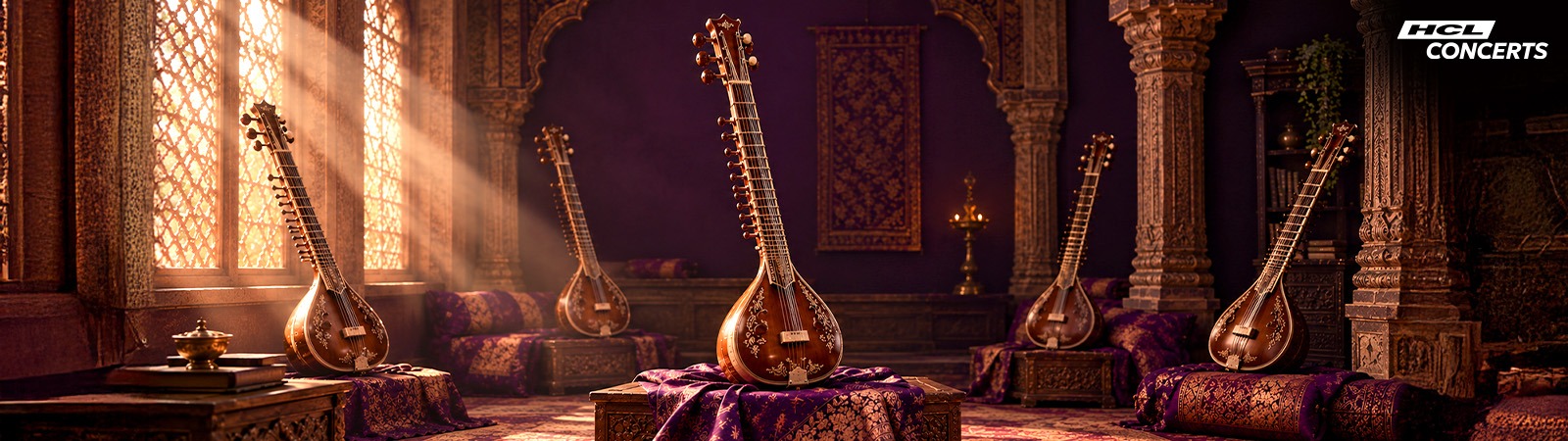
The Role of Sitar in Hindustani Classical Music
2026-10-28The sitar reached a global audience in the 1960s: George Harrison played it on the Beatles’ “Norwegian Wood” in 1965, and Brian Jones used it on the Rolling Stones’ “Paint It Black” the following year. Back home, Pandit Ravi Shankar’s score for Satyajit Ray’s Pather Panchali (1955) gave Indian cinema one of its most memorable soundtracks.
The instrument’s story, though, is far older. It grew out of the Persian setar, a three-stringed lute that travelled to India with Persian and Central Asian musicians in the medieval period. Indian players and craftsmen reshaped it, adding movable frets, more strings, and a set of sympathetic strings, and the result suited the Hindustani raga far better than any imported lute could. By the 18th century it was a court instrument, and by the 20th it had become the best-known voice of Indian classical music abroad. Let’s look at its origins, construction, sound, role in performance, and the players who shaped it.
The Sitar Instrument: Origins and Design
From a distance, the sitar instrument looks like a long neck, a round body and a tangle of strings. Up close, every part serves the sound.
Origins: From Persian Setar to Indian Sitar
The name comes from the Persian “setar”, meaning three strings. Many accounts credit the 13th-century poet-musician Amir Khusrau with inventing the sitar. That story is a cherished tradition rather than settled history, and no firm evidence ties him to it. What is clearer is the pattern of change: Persian lutes arrived through the Delhi Sultanate and Mughal courts and met native instruments such as the veena.
Over generations, frets became curved and movable, strings multiplied, and sympathetic strings appeared. Tradition links two court musicians, Masit Khan and Raza Khan, with the slow Masitkhani gat and the fast Razakhani gat, compositions still played today. By the 18th century, a recognisable sitar was heard in the courts of North India.
Anatomy: Gourd, Frets, and Sitar Strings
- Tumba: The large gourd at the base, which acts as the main resonator. A smaller gourd often sits near the top of the neck.
- Dandi: The hollow wooden neck that carries frets and strings.
- Frets: Curved metal bars tied to the neck with thread. They can be shifted to suit the raga.
- Sitar strings: Six or seven main strings, including the chikari drone strings, plus about a dozen sympathetic strings below the frets.
The Sound of the Sitar
That shimmering, buzzing, singing tone comes from details no other instrument shares in quite the same way.
Playing Technique: Meend, Jawari, and the Mizrab
Sitar playing rests on three ideas.
- Meend: Pulling a main string sideways across a fret. The pitch glides upward, sometimes by several notes in a single stroke. It sounds like a voice sliding between notes, and it is the instrument’s greatest expressive tool.
- Jawari: The wide, gently curved bridge. Its shape lets the string brush the bridge surface as it vibrates, producing the silvery buzz that defines the sitar. Adjusting the jawari is delicate work. A tiny change can alter the sound’s character.
- Mizrab: The wire plectrum worn on the right-hand index finger. Every note begins with its sharp, bright strike, and fast passages demand a strong, steady wrist.
Sympathetic Strings and Resonance
Below the main strings lie the tarab strings, which are never plucked directly. They vibrate in sympathy when a note on the main strings matches their pitch, creating a soft ringing halo that lingers after each note. That is why a sitar seems to hold a note in the air.
The Sitar’s Role in Hindustani Classical Music
In a performance, the sitar player usually leads. A tanpura sets the drone, and a tabla player joins later. The sitar player unfolds a raga with patience, one note at a time.
Alap, Jor, and Jhala: Structure of a Sitar Performance
A traditional performance grows in stages.
- Alap: A slow, unmetered opening with no tabla. The player introduces the raga note by note.
- Jor: A pulse enters, though still without tabla. The playing becomes rhythmic.
- Jhala: The fastest section. The player strikes the chikari strings in quick succession, building excitement.
- Gat: A composition set to a tala, played with tabla. Slow Masitkhani and fast Razakhani gats are common.
What to Expect at a Sitar Recital
- Arrive early. Seats fill quickly, and tuning is part of the experience.
- Switch off your phone. The quietest passages are the most delicate.
- Do not worry about knowing the raga. Artists often introduce it.
- Let the alap take its time. It may feel slow at first, but then it draws you in.
- Applaud when moved. Listeners often clap after a brilliant passage, especially during tabla exchanges.
Legendary Sitar Players and Their Legacy
Today’s sitar musicians keep this inheritance alive. A few names stand above the rest in the instrument’s story.
Pandit Ravi Shankar and Ustad Vilayat Khan
- Pandit Ravi Shankar (1920-2012), a disciple of Baba Allauddin Khan of the Maihar gharana, carried the sitar worldwide. He performed at Monterey in 1967 and Woodstock in 1969 and received the Bharat Ratna in 1999. His playing combined structure with deep devotion.
- Ustad Vilayat Khan (1928-2004), of the Imdadkhani gharana, developed the gayaki ang, a style that imitates the human voice. His meend work was extraordinary, and his tone was sweet and vocal. Where Ravi Shankar impressed with architecture, Vilayat Khan moved listeners with song.
Sitar Musicians Carrying the Tradition Forward Today
- Anupama Bhagwat, a leading sitarist of the Imdadkhani gharana, trained under Pandit Bimalendu Mukherjee for over two decades. Her playing combines the meditative unfolding of the alap with fast taans and the expressive gayaki ang, which brings the nuances of the human voice to the sitar. Since beginning her international performances in 1995, she has played at festivals and venues across India, Europe and North America, balancing technical precision with lyrical depth.
- Purbayan Chatterjee, a sitarist of the Senia Maihar gharana, is known for bringing Hindustani classical music into conversation with jazz, world music and other contemporary styles. Influenced by Pandit Nikhil Banerjee’s musical traditions and Ustad Amir Khan’s vocal expression, he combines the structure of raga performance with an exploratory approach to melody. His collaborations with artists, including Ustad Zakir Hussain, Béla Fleck and Herbie Hancock reflect his interest in crossing musical boundaries while keeping Indian classical music at the centre of his work.
Why the Sitar Continues to Matter
The sitar is not a museum piece. Students learn it in gurukuls and music schools, and young players post their riyaz online. Fusion artists pair it with electronic beats and jazz. That openness keeps it alive. A tradition that cannot change often fades, while one that welcomes new listeners grows.
Conclusion
The sitar is the enchanting voice of Hindustani classical music. Its gourd gives warmth, its jawari adds shimmer and its sympathetic strings leave a lingering glow. HCL Concerts has brought more than 3,600 artists to over 280+ digital concerts, with an audience of over 18 crore people worldwide. Ustad Shujaat Khan, one of India’s best-known sitar players, has appeared on its lineups. Find a live concert near you, take a seat, and let the alap carry you wherever it wishes.