The History of Indian Classical Music and Its Enduring Legacy
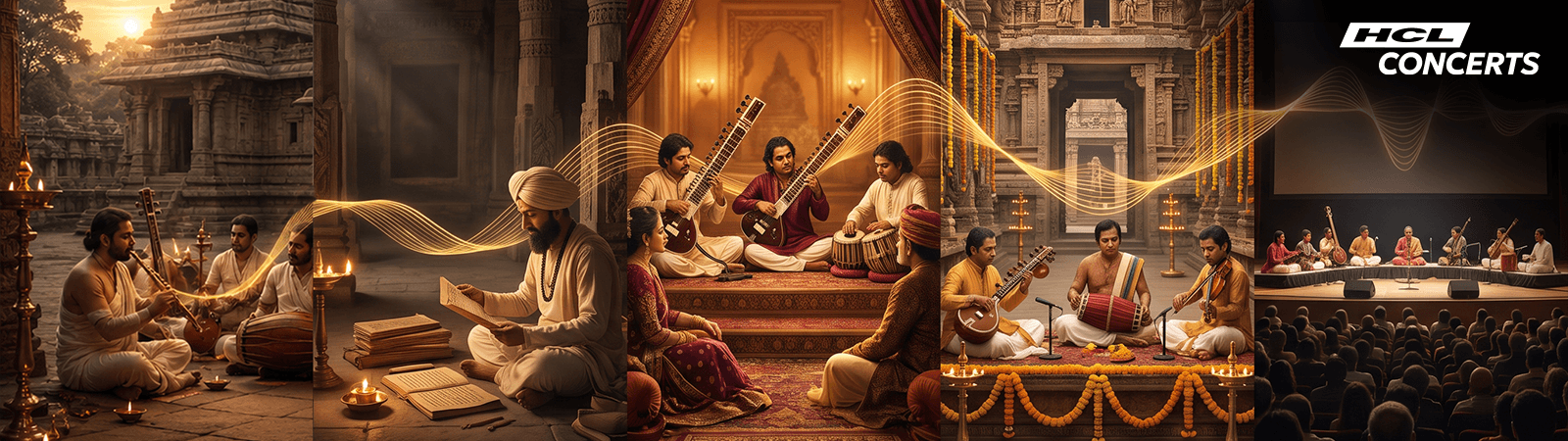
2026-07-09Few things on earth have been sung continuously for three thousand years. Empires have risen and fallen, languages have been forgotten, yet the same ragas that echoed through ancient temples are still performed on a stage tonight. The history of Indian classical music is not a closed chapter in a textbook; it is a living thread, unbroken, stretching from Vedic chant to the modern concert halls. Of all the Indian performing arts, none reaches back so far while remaining so alive.
Why Indian Classical Music’s History Is Unlike Any Other Tradition
What sets this tradition apart is its sheer continuity. Many ancient musical systems have vanished or survive only as reconstructions. Indian classical music, by contrast, has been passed from mouth to ear, from guru to their shishya, for millennia, evolving constantly, yet never breaking its roots.
The Origins of Indian Classical Music
To trace the origin of Indian classical music, we must travel back to a time before notation, before instruments as we know them today, to the sacred sound itself. Its earliest stirrings, the very Indian classical music, lie not in entertainment but in worship: in ritual chant and the temple music of the ancient world, where melody was a way of reaching the divine.
Vedic Chanting and the Roots in Sama Veda
Most scholars place the true origin of Indian classical music in the Sama Veda, one of the four Vedas, composed over three thousand years ago. While the Rigveda gave us sacred verses, the Sama Veda set many to melody, to be sung rather than recited. This samagana, the chanting of hymns across a few carefully ordered notes, is widely cited as the earliest documented music in India, the seed from which everything later grew.
The Natyashastra and Early Musical Theory
Centuries later came the first great attempt to write it all down. The Natyashastra, attributed to the sage Bharata and composed roughly two thousand years ago, was a sweeping treatise on theatre, dance and music. It set out early principles of melody and rhythm, scales, microtones and metrical cycles that later blossomed into the raga and tala systems. It remains the theoretical bedrock on which the whole tradition stands today.
The Split into Hindustani and Carnatic Traditions
For much of its early life, Indian classical music flowed as a single stream. Then, from around the thirteenth century, it gradually divided into two great traditions, Hindustani in north India and Carnatic in south India, each with its own instruments, guidelines, music and temperament, yet both still rooted in the same ancient raga system.
How Persian and Mughal Influence Shaped Hindustani Music
The northern branch was reshaped by centuries of contact with Persian and Central Asian culture. Hindustani music began well before the Mughals: as early as the thirteenth century, under Delhi Sultanate rulers such as Alauddin Khilji. His court poet, Amir Khusrau, is credited with introducing enduring forms, chief among them the tarana with its rhythmic syllables. When the Mughal courts flourished from the sixteenth century, that exchange deepened, bringing fresh melodic ideas, new instruments and a courtly polish. Under royal patronage, the tradition reached one of its highest points at Akbar’s court, where Tansen sang.
How Carnatic Music Preserved Its Ancient Roots
The southern branch took a different path. Shielded from much of that northern influence, Carnatic music stayed closer to its devotional origins, remaining deeply tied to temple music and worship. Its compositions, many in Sanskrit, Telugu and Tamil, are overwhelmingly sacred, and were later systematised by saint-composers such as Purandara Dasa and the revered Carnatic trinity.
Key Eras That Shaped Indian Music
No account of the history of Indian classical music is complete without its turning points, the eras that patronised it, threatened it and ultimately reinvented it. These milestones, central to both Carnatic and Hindustani music history, carried the tradition from the palace to the public.
The Court Patronage Era
For hundreds of years, classical music lived inside royal courts. Kings, nawabs, and princely rulers competed to keep the best musicians, who, in return, had the freedom to perfect their art over a lifetime. This support shaped the music’s style, manners and gave the tradition the stability to grow richer with every generation.
The Colonial Period and Its Disruptions
Western rule over India unsettled this delicate ecosystem. As princely fortunes faded, the courtly patronage that had sustained musicians for centuries began to collapse, a pivotal disruption in Hindustani music history. Many performers lost their patrons and sought new listeners beyond the palace walls, a difficult shift that would, unexpectedly, open the music to a far wider audience.
The Rise of the Concert Stage in the 20th Century
That wider audience arrived in the twentieth century. Music moved out of courts and temples and onto the public stages, helped by reformers who founded schools, fixed notation and organised ticketed concerts. Radio, recordings and the modern recital carried the ragas to ordinary listeners, turning a once-courtly art into a shared national treasure.
Instruments and Forms That Carried This Legacy Forward
History survives in sound and shape of the music. Much of these legacy lives on in the instruments and forms that still draw thousands of audiences. The sitar, sarod, tabla, veena, and bansuri turned instrumental music into a vehicle for the deepest expression, while an equally rich vocal tradition ran alongside them.
From Dhrupad to Khayal: An Evolving Vocal Tradition
The oldest surviving form of Hindustani vocal music is dhrupad: austere, meditative and profound. From the eighteenth century onward, a more flexible, ornamented style called khayal rose to prominence, offering greater room for improvisation and feeling. Yet for all this change, the underlying raga theory held firm, and instrumental music evolved hand in hand with the voice, each forever borrowing from the other.
Why Indian Classical Music’s Legacy Still Matters
So why does any of this matter now? Because, unlike so many Indian performing arts of the ancient world, this one never quietened into a relic.
A Living Tradition, not a Museum Piece
The ragas described in centuries-old texts are not just museum exhibits; they are performed, taught and loved as a living art. A student today learns through the same oral tradition that shaped musicians a thousand years ago. Nothing here is forgotten; every performance reinterprets the past in the present.
Global Recognition and Fusion with Other Genres
In the last century, the tradition also went global. Pioneers such as Ravi Shankar carried the sitar to Western audiences, influencing rock, jazz and beyond. John Coltrane drew on its ideas, The Beatles embraced the sitar, and film composers borrowed its colours. Today, Indian classical music thrives on various stages including fusion projects and on world stages, ancient yet endlessly adaptable.
Conclusion
From a single chanted verse in the Sama Veda to a packed modern auditorium, the history of Indian classical music is really one continuous thread never cut, only lengthened. It has outlasted empires, colonisation and the rush of modern life, not by resisting change but by quietly absorbing it. That is its enduring miracle: an ancient voice still singing, generation after generation, with no sign of falling silent.