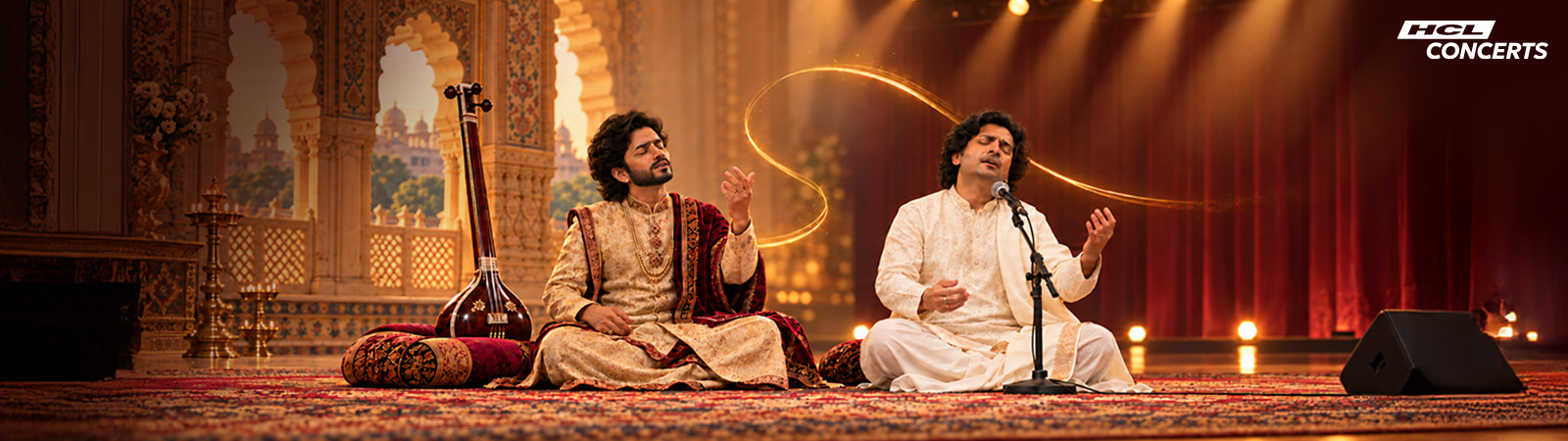
Famous Hindustani Classical Singers Who Shaped Indian Music
2026-10-07Hindustani vocal music has a history that stretches back centuries. The oldest surviving form, dhrupad, flourished in temples and royal courts and reached its peak under Emperor Akbar, whose court musician, Miyan Tansen, became a legend. In the 18th century, khayal gained popularity at the Mughal court of Muhammad Shah Rangila. Composers such as Niyamat Khan, known as Sadarang, wrote many of the compositions still sung today.
As the Mughal Empire declined, musicians moved to princely states such as Gwalior, Jaipur, Rampur, Patiala and Indore. Each court developed its own style, and these styles gradually evolved into distinct gharanas. In the twentieth century, patronage shifted again. Radio, gramophone records, public concerts and music festivals took classical singing out of palaces and into ordinary homes.
That shift produced some of the most celebrated Hindustani singers in history. Here, we look at who these singers were, the gharanas that shaped them, the training behind their voices, and the artists carrying the tradition forward today.
Who Are Hindustani Classical Singers?
Hindustani music is one of the two major traditions of Indian classical music, alongside Carnatic music. Rooted in North India, it has grown and changed over centuries, bringing together ancient ragas, rich musical traditions, and new influences along the way. But Hindustani music is about much more than melody and rhythm. It carries stories, emotions and ideas, with knowledge traditionally passed from guru to shishya through years of close learning and practice. From the legendary Tansen, who performed at the court of Emperor Akbar, to musicians working today, each generation has found its own way to build on the tradition.
Much of what makes Hindustani music so captivating is its freedom to unfold differently in every performance. A musician can explore a raga through improvisation, subtle shifts in pitch and changes in rhythm, allowing the music to develop naturally in the moment. The sound of Ustad Bismillah Khan’s shehnai or Ravi Shankar’s sitar shows how deeply personal this tradition can be. Their music reached audiences far beyond India, introducing Hindustani classical music to listeners worldwide while keeping its roots firmly intact.
A Hindustani classical singer performs ragas in forms such as dhrupad, khayal, thumri, and tappa. The raga provides the rules: which notes to use, how to approach them, and which phrases define the mood. Within those rules, the singer improvises, so no two performances are the same.
The Gharana System: Schools That Shaped Hindustani Vocalists
A gharana is a musical lineage passed from guru to disciple. Each has its own approach to voice production, raga development, and ornamentation. The major vocal gharanas that shaped Hindustani classical music singers include:
- Gwalior: The oldest khayal gharana, known for clarity and balanced structure.
- Agra: Forceful, rhythmic singing with strong dhrupad roots.
- Kirana: Slow, note-by-note development and a focus on pure tone.
- Jaipur-Atrauli: Complex, winding phrases and a taste for rare ragas.
- Patiala: Fast, ornate taans and a strong thumri tradition.
- Indore: Introspective, very slow khayal.
- Mewati: Devotional warmth and melodic sweetness.
Legendary Hindustani Classical Singers of the 20th Century
The singers below are grouped by gharana to show how each lineage produced its own giants.
Pandit Bhimsen Joshi
The Kirana gharana was shaped by Ustad Abdul Karim Khan and Ustad Abdul Wahid Khan, and its line passed through Sawai Gandharva to Pt. Bhimsen Joshi. Joshi left home as a boy to find a guru and became one of India’s most loved voices, known for power, sustained notes, and abhangs. He received the Bharat Ratna in 2008. His gurubhagini, Gangubai Hangal, was another great Kirana voice.
Kishori Amonkar
Founded by Ustad Alladiya Khan, the Jaipur-Atrauli gharana is known for intricate phrasing. Kishori Amonkar learned from her mother, Mogubai Kurdikar, a disciple of Alladiya Khan. She sang with great emotional intensity and received the Padma Vibhushan. Pt. Mallikarjun Mansur also belonged to this gharana, famous for rare ragas sung with ease.
Ustad Amir Khan
Ustad Amir Khan developed the Indore Gharana himself. He sang at an extremely slow tempo and used the merukhand system, exploring notes in careful permutations. His Raag Marwa and Darbari recordings are studied by singers across the gharanas.
Ustad Bade Ghulam Ali Khan
The greatest name of the Patiala gharana, Ustad Bade Ghulam Ali Khan, had a remarkable range and agility. His thumri Yaad Piya Ki Aaye is still widely sung, and his song Prem Jogan Ban Ke in Mughal-e-Azam brought classical music to cinema audiences. He received the Padma Bhushan in 1962. The Patiala style continues through Pt. Ajoy Chakrabarty and his daughter Kaushiki Chakraborty.
Other Iconic Hindustani Classical Music Singers
- Ustad Faiyaz Khan (Agra): Known for commanding voice and bold rhythmic play.
- Pt. Kumar Gandharva: Trained under Prof. B. R. Deodhar but developed an independent style drawing on Malwa folk songs and Kabir’s nirguni bhajans.
- Pt. Jasraj (Mewati): Brought a devotional glow to khayal and popularised the gharana worldwide.
- Ustad Rashid Khan (Rampur-Sahaswan): A powerful voice who bridged tradition and wider popularity.
HCL Concerts has also hosted gifted voices shaped by these traditions.
- Shubha Mudgal presented an exclusive Baithak for HCL Concerts, blending traditional Indian music with fusion.
- Hindustani classical vocalist Omkar Dadarkar, trained at the ITC Sangeet Research Academy, has also performed at Baithak.
- Nirali Kartik, a disciple of Pt Sanjeev Abhyankar and co-founder of Maati-Baani, also performed a session, carrying forward the Mewati lineage of Pt. Jasraj through her guru.
- Vocalist Swarndeep Chatterjee appeared in the early Baithak line-up in April 2020.
What Makes a Great Hindustani Vocalist
Talent matters, but it is only the starting point. What separates a great Hindustani vocalist is craft built over decades.
Voice Culture, Riyaz, and Raga Mastery
Riyaz is a daily practice. Many singers begin with kharaj, holding low notes for long periods to build depth and steadiness. Raga mastery goes further than knowing the notes. A Hindustani classical vocalist must know how each raga moves, which notes to rest on, and which phrases belong only to it.
Hindustani Vocalist Training: The Long Road to Mastery
Training traditionally follows the guru-shishya parampara. The student learns by repeating the teacher’s phrases until they sit correctly. A Hindustani vocalist may train for ten to fifteen years before giving major concerts, and most keep learning throughout their careers.
Improvisation: The Heart of Hindustani Singing
Khayal begins with a short composition, the bandish, and grows through slow alaap, rhythmic bol-baant, and fast taans. The singer improvises freely but never breaks the raga’s rules.
The Best Hindustani Classical Singers Performing Today
Among the best Hindustani classical singers active now are Kaushiki Chakraborty, Ashwini Bhide Deshpande, Pt. Ulhas Kashalkar, Pt. Venkatesh Kumar, Pt. Sanjeev Abhyankar, and Pt. Jayateerth Mevundi. Many younger listeners are finding them through streaming and social media.
These singers are custodians of a living tradition. HCL Concerts works to keep that tradition visible and accessible. Through Baithak sessions, live events, podcasts, and artist stories, it helps audiences connect with both renowned masters and emerging Hindustani singers. Baithak recordings can be watched anytime, focusing on intimate performances rather than big lights or grand stages. Tune in to a session and hear the gharanas come alive.