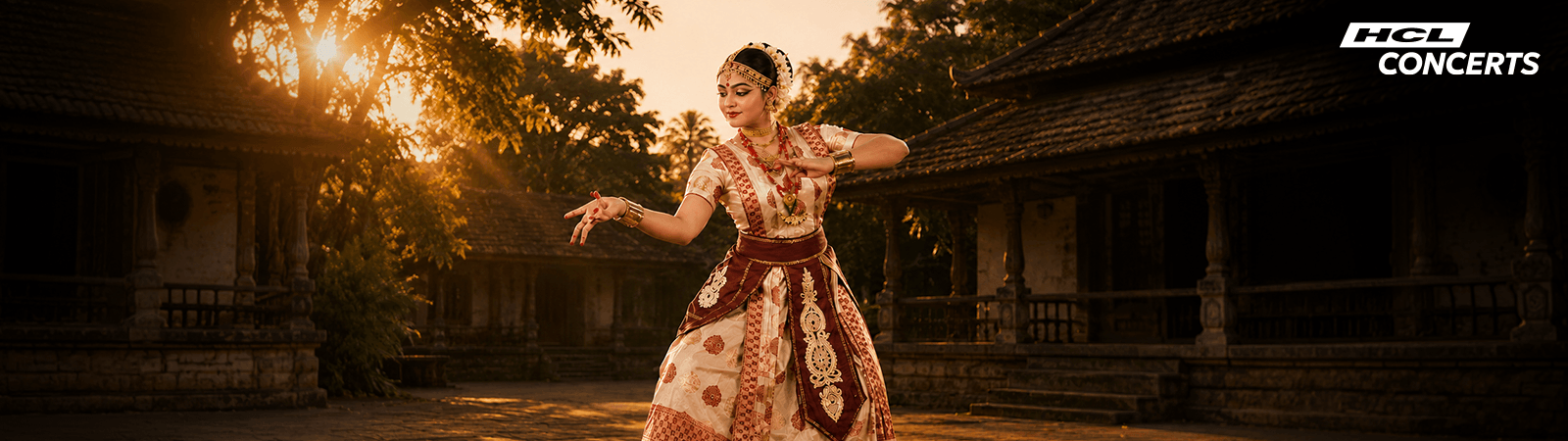
Sattriya Dance and the Role of Nritta and Nritya
2026-09-18What Is Sattriya Dance?
In simple terms, Sattriya dance is one of India’s eight classical dances, originating from the state of Assam. Its name comes from the sattras, the Vaishnavite monasteries where it was born and preserved for centuries. Uniquely among the eight, it grew not in royal courts or southern temples but within a living monastic community, which is why devotion runs through every step.
The Origins of Sattriya: A Dance Born in the Sattras
To trace the form to its source is to travel back to fifteenth and sixteenth-century Assam and to one remarkable saint.
Mahapurush Sankardev and the Founding of Sattriya
The form was created by Mahapurush Srimanta Sankardev (1449–1568), the saint-scholar and reformer who led Assam’s neo-Vaishnavite Bhakti movement. With his disciple Madhavdev, he shaped dance, music, and drama into a single devotional art, using it to spread devotion to Krishna. For Sankardev, dance was never entertainment; it was a way of worshipping and making scripture visible to ordinary people.
Sattriya as a Ritual and Performance Tradition
For centuries, the dance stayed exactly where it began: inside the sattras. It was performed by bhokots, celibate male monks, as part of daily worship and festivals rather than for any outside audience. This seclusion had a remarkable side effect. Sheltered from fashion and commerce, Sattriya kept its original form with extraordinary purity, passing unbroken from guru to disciple until it stepped onto the public stage in the twentieth century.
Understanding Nritta and Nritya in Sattriya
Like every Indian classical dance, Sattriya is built on three contrasting components including nritta, nritya and natya with the two contrasting elements being: nritta and nritya. Grasp the difference between them, and a whole performance opens up.
Nritta: Pure Dance and the Technical Foundation
Nritta is pure dance movement for its own sake, with no story attached. It is all rhythm, line and energy: crisp footwork, turns and precise poses that follow the beat rather than any narrative. In Sattriya, nritta sets the structure and pulse of a piece, showcasing the dancer’s control and the geometry of the form, the technical foundation on which everything expressive is later built.
Nritya: Expression and Storytelling
Nritya is where meaning enters. The dancer combines rhythm with abhinaya, using the face, hands, and body to tell a story, usually drawn from Vaishnavite scripture and the life of Krishna. This is expressive dance at its fullest: an eyebrow, a curved hand, or a shift of gaze can convey longing, mischief, or divine love. If nritta is the body’s discipline, nritya is its voice.
How Nritta and Nritya Work Together in a Performance
In practice, a Sattriya performance flows constantly between the two. A passage of pure rhythmic nritta might give way to a tender expressive episode, then return to crisp footwork, a call and response between technique and emotion. This weaving of the two gives the form both its rigour and its heart, holding an audience between admiration and feeling.
The Visual and Musical Elements of Sattriya
Sattriya is not only movement, it is a complete sensory world, wrapped in distinctive costume and carried by a music all its own. To watch it fully, it helps to know what you are seeing and hearing.
Traditional Costumes and Aharya
Much of Sattriya’s visual beauty lies in its aharya, the costume and adornment. The attire is traditionally crafted from Assam’s own Pat silk, prized for its natural sheen, and finished with distinctive traditional jewellery. Male dancers wear a dhoti and chadar with a turban, while female dancers wear a stitched skirt (ghuri) and blouse (kanchi), often with a waist cloth. Every element, from the woven motifs to the jewellery, is rooted in Assamese culture, giving the form its unmistakable look.
Musical Accompaniment: Borgeet and Traditional Instruments
A Sattriya performance is incomplete without its music. The dance moves in intimate dialogue with a small ensemble of singers and instrumentalists, whose rhythms and melodies cue every step and gesture. This is not background sound but an equal partner: the music sets the devotional mood, marks the rhythmic cycle, and gives the dancer the emotional ground on which the whole performance is built.
The Role of Borgeet, Khol, and Taal in Sattriya
At the heart of that music sit three elements. The Borgeet, literally “great songs”, are the devotional compositions written by Sankardev and Madhavdev themselves, and they lend the dance its sacred voice. Driving the rhythm is the Khol, a two-faced clay drum with a bright, resonant tone unique to the tradition, while the Taal, or cymbals, mark the beat and bind dancer and drummer together. Borgeet, Khol and Taal are what make a Sattriya performance sound like nothing else in Indian dance.
Mati Akhora: The Foundation of Sattriya Training
Before any of that beauty is possible, though, comes the groundwork with which every Sattriya dancer begins.
What Mati Akhora Is and Why It Matters
Mati akhora literally means “floor exercises”, and that is exactly what it is: a set of foundational movements every student masters first. They are to Sattriya what the adavus are to Bharatanatyam, the building blocks from which all later choreography is assembled. No dancer skips them; the entire vocabulary of the form grows out of these early, repetitive drills.
How Mati Akhora Develops a Dancer’s Body and Timing
Its purpose is as much physical as it is artistic. Practised daily, these exercises build the posture, stamina and core strength that Sattriya demands, while training the body to move in time with rhythm. Mati Akhora also introduces dancers to the contrasting qualities of Tandava, with its vigorous and dynamic movements, and Lasya, marked by softer, more graceful movement.
Together, these qualities teach a dancer when to ground a movement with strength and when to let it flow with ease. They instil Sattriya’s characteristic stances and clean lines, so that correct form becomes instinctive rather than laboured. It is slow, humbling work, and it is what gives a trained dancer the control to move with both precision and grace.
The Language of the Body: Mudras and Movement
If those drills build the body, it is the body’s language that lets it speak. Sattriya conveys meaning through a precise vocabulary of gesture and movement, and at its centre sit the dance mudras.
Hand Gestures (Mudras) in Sattriya
Like the other classical forms, Sattriya has its own codified set of hastas, or hand gestures. These dance mudras are a kind of sign language: a single hand gesture can represent a deity, a lotus, a deer, or an emotion, and, in combination, they narrate whole verses. Learning them is like learning an alphabet, the raw material from which a dancer builds sentences of meaning.
Footwork, Eye Movements, and Full-Body Expression
But the hands are only part of it. Sattriya is a full-body language: footwork marks the beat, the neck and eyes dart and glide to direct attention, and posture shifts to signal a change of character or mood. Nothing is decorative for its own sake. In this expressive dance, every raised eyebrow and turn of the wrist carries a fragment of the story.
Sattriya on the Concert Stage Today
For all its ancient roots, Sattriya’s life as a mainstream classical dance form is surprisingly recent – just over two decades old at the national level.
How Sattriya Was Recognised as India’s Eighth Classical Dance
It was only on 15 November 2000 that the Sangeet Natak Akademi, India’s national academy for the performing arts, formally recognised Sattriya as the country’s eighth classical dance alongside Bharatanatyam, Kathak, Kathakali, Kuchipudi, Odissi, Manipuri and Mohiniyattam. Recognition changed everything: it drew students, scholars, and festival invitations, lifting the form out of the monasteries and onto stages across India and the world.
Artists Keeping Sattriya Alive Today
Much of that journey was driven by dedicated gurus. Nrityacharya Jatin Goswami, honoured with the Padma Bhushan, was pivotal in carrying Sattriya from the Sattras to national and international stages. Haricharan Saikia, a veteran of the Kamalabari Sattra tradition in Majuli and a recent Padma Shri awardee, has spent a lifetime teaching and preserving the form. Between them and a rising generation of dancers, Sattriya has rarely been in safer hands.
Conclusion
That is the quiet wonder of Sattriya dance. Born as worship and shaped over five centuries in the monasteries of Assam, it is a classical dance form in which devotion and technique were never rivals but partners, the discipline of nritta and the feeling of nritya bound in a single act of faith. To watch it is to see something rare: prayer made visible, still dancing, five hundred years on.