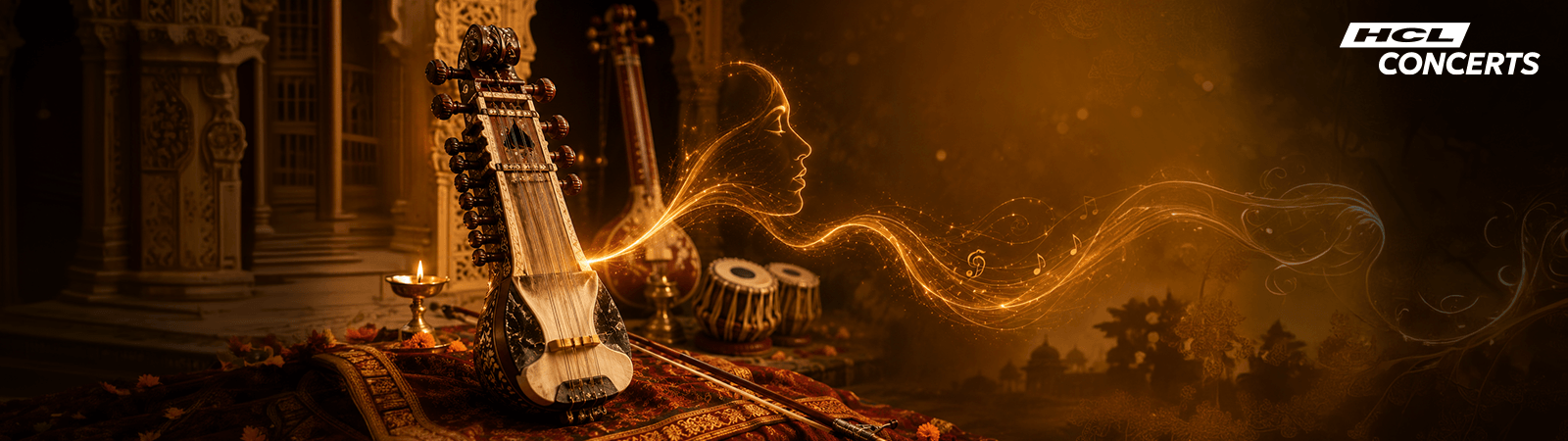
Why the Sarangi Is Known as the Voice of Indian Classical Music
2026-07-14On a Hindustani stage, the vocalist is rarely alone. Just to one side sits a second musician, bowing a small instrument, shadowing the singer note for note, sliding when they slide, pausing when they pause for breath. That instrument is the sarangi, and it does not so much accompany the voice as become it. Of all the instruments in Indian classical music, none mirrors human singing quite so closely. This is the story of how the sarangi musical instrument earned its strange, beautiful nickname, “the voice of Indian classical music” and why we very nearly lost it.
The Sarangi’s Role in Indian Classical Music
For most of its long history, the sarangi has been a supporting instrument. Within Hindustani classical music, it traditionally sat beside vocalists rather than in the spotlight, yet that humble role made it indispensable and shaped everything the instrument would become.
Accompanying Vocalists: Why Sarangi Is the Preferred Choice
Indian singing lives in the spaces between the notes, the tiny slides, bends and shakes that give a raga its emotion. Fixed-pitch instruments like the harmonium can only jump from note to note; they cannot truly glide. The sarangi can. Because it has no frets, and its strings are stopped with the nails rather than the fingertips, a player slithers seamlessly between pitches, tracing every microtone and gamaka (ornament) a vocalist produces. For generations, that made it the accompanist singers trusted above all others.
Sarangi as a Solo Instrument
For a long time, though, the sarangi stayed in that supporting seat. The idea of a full solo recital, an evening of sarangi music with only a tabla for company remained rare until the twentieth century. It took one extraordinary musician to establish the sarangi as a solo concert instrument in its own right and win it a wide audience: Pandit Ram Narayan, whose story we will come to shortly.
Its Place in the Tabla – Sarangi Duo Tradition
When the sarangi does take centre stage, it is almost always paired with the tabla. Together, the two frame a Hindustani classical music performance like a conversation: the sarangi unfolds the raga, slow and searching, while the tabla enters with rhythm, and the pair push one another towards faster, brighter peaks. In a percussion-led recital, the sarangi returns the favour, holding a repeating phrase, the lehra, so that the drummer can improvise above it.
Why the Sarangi Is Called the Voice of Indian Classical Music
So why “the voice”? The answer lies where the instrument’s anatomy, technique, and role all meet, and it begins with the sarangi’s extraordinary sound, a quality unmatched for centuries. That instrument is the sarangi, whose name is often traced, in popular tradition, to sau rang, “a hundred colours”, for the range of moods it can summon. Of all the indian musical instruments, none mirrors human singing quite so closely.
Tonal Similarity to the Human Voice
Among all the Indian musical instruments, few are built quite like this. Carved from a single block of tun (Indian Red Cedar) and strung with gut, the sarangi has a tone unlike anything else: warm, reedy and faintly mournful, with a catch listeners often describe as weeping. Beneath its three main strings run a bank of sympathetic strings, typically thirty-five to forty, depending on the maker and school, tuned to the raga, which shimmer into life on their own and wrap every note in a soft halo. It is this timbre, breathy, human, aching, that makes sarangi music sound less like a string and more like someone singing.
Its Ability to Follow Every Nuance of a Raga
Timbre is only half the story. Because the player slides along the strings with the cuticles, the sarangi can produce meend, the long, unbroken glide between notes that is the very soul of an Indian raga. It can bend, swell and ornament a phrase exactly as a singer would, catching the subtlest inflection of an Indian raga that a keyed instrument would flatten. To follow a sarangi is, quite literally, to follow the human voice through the raga.
Famous Sarangi Players Who Defined the Instrument
No instrument survives on acoustics alone; it needs champions. Among Indian musical instruments, the sarangi has been blessed with a handful of players whose artistry has kept it alive, and with one sarangi player in particular who changed its destiny entirely.
Ustad Bundu Khan and the Early Masters
In the early twentieth century, masters such as Ustad Bundu Khan, widely regarded as one of the greatest the instrument has known, were among the first to lift the sarangi from the accompanist’s chair towards genuine concert prominence. Alongside contemporaries like Mamman Khan and Shakoor Khan, they showed it deserved an audience of its own.
Ram Narayan and the Rise of Solo Sarangi
But it was Pandit Ram Narayan who truly transformed the sarangi from accompaniment into a solo voice. From his first solo concerts in 1956, the late maestro, who passed away in 2024 at age 96, spent a lifetime proving that the instrument could carry a full raga on its own. His international tours from the 1960s made him the first sarangi player to win global fame and earned him the Padma Vibhushan, India’s second-highest civilian honour.
Artists Keeping the Tradition Alive Today
That legacy now rests in younger hands. Ram Narayan’s daughter Aruna and grandson Harsh both perform internationally, while players such as Kamal Sabri, carrying a seven-generation family tradition, and Murad Ali Khan keep it on concert stages. Others, like Suhail Yusuf Khan, carry its voice into fusion and world music for new audiences.
Why the Harmonium Displaced the Sarangi in Many Settings
The hard truth is practical. The sarangi is famously difficult: it can take years to produce a clean note, and longer to master its slippery, nail-stopped technique. The harmonium, by contrast, is cheap, portable and quick to learn; press a key, and it sounds. As royal patronage faded and musicians travelled more, that convenience won out, and the harmonium quietly replaced the sarangi in countless concerts.
New Interest Among Younger Musicians and Global Listeners
Yet the obituaries proved premature. A new generation of players is taking up the instrument, drawn by the very expressiveness that makes it so hard. International students now travel to India to learn it. The sarangi appears at world-music festivals and on film soundtracks, and fresh recordings are finding listeners far beyond the subcontinent. The hundred colours (sau rang), it seems, are not fading yet.
Conclusion
So here is an invitation. At the next live concert you attend, when the singer falls quiet and that small bowed instrument answers in their place, let your eyes fall shut and follow it. The sarangi musical instrument will lead you, slide by aching slide, into the heart of the raga. For all that Hindustani classical music has changed across the centuries, no other sound has spoken quite so directly, which is exactly why the sarangi is, and always has been, its truest voice.